
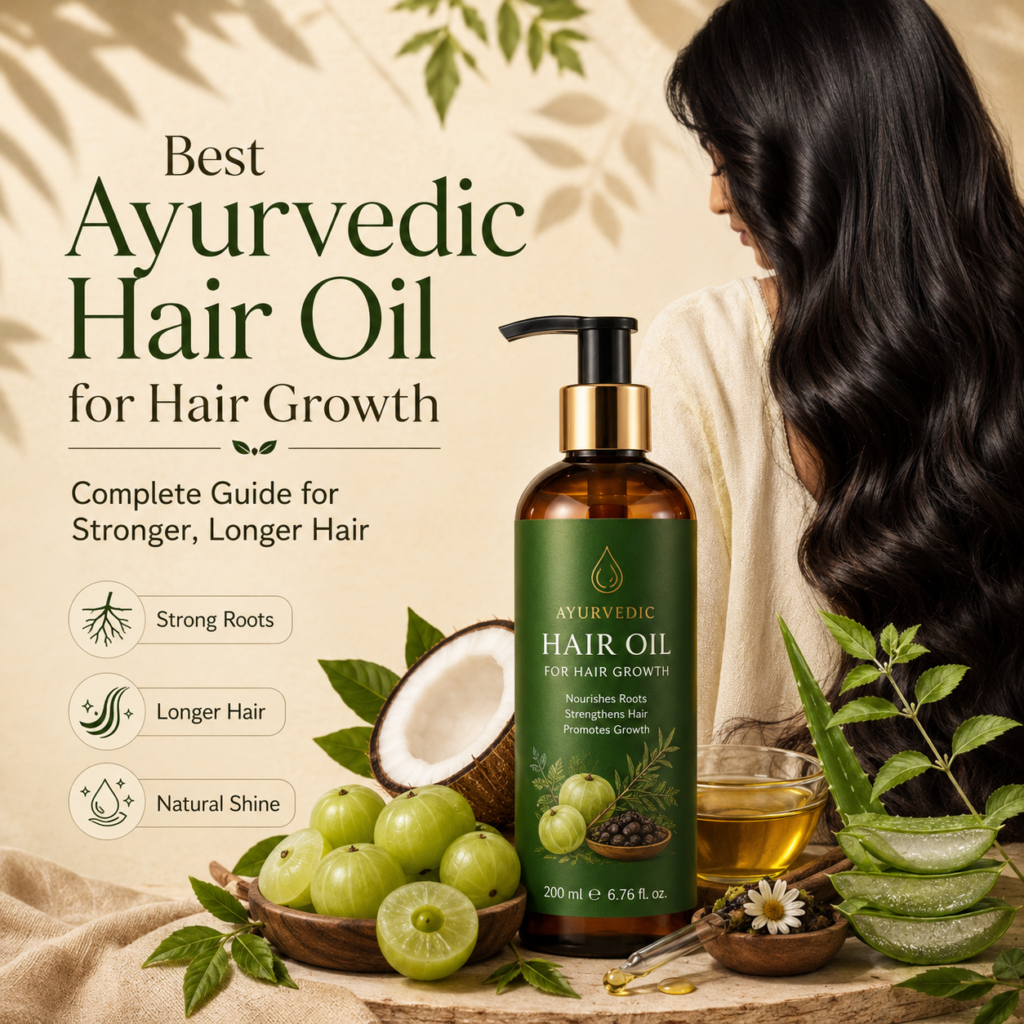
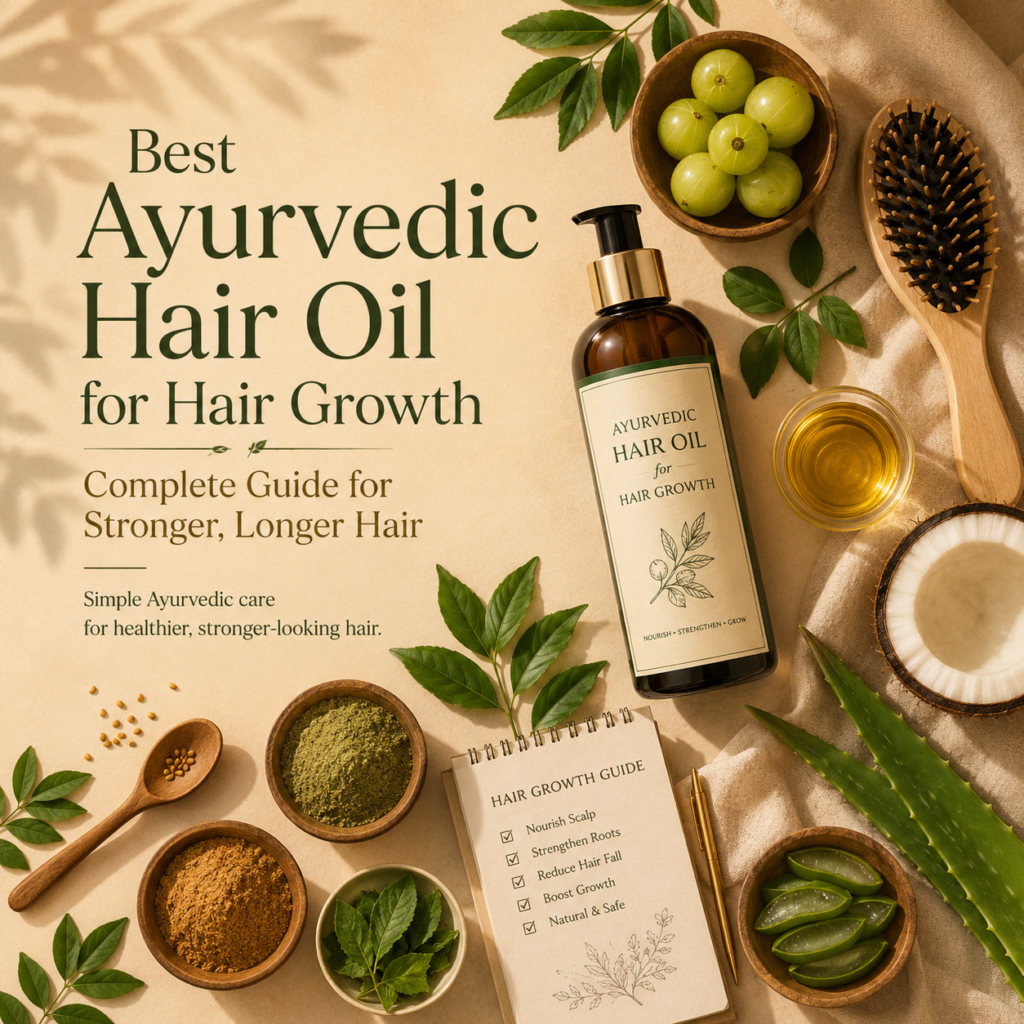
Hair growth is not only about applying oil and waiting for longer hair. It depends on scalp health, hair roots, nutrition, stress, hormones, breakage control, and how regularly you care for your hair. That is why many people in India still prefer an ayurvedic hair oil for hair growth as part of their weekly hair care routine.
A good Ayurvedic oil works best when it supports the scalp, nourishes the hair shaft, reduces dryness, and helps protect the length from breakage. It cannot change your genetics or cure medical hair loss overnight, but it can support healthier-looking hair when used consistently with the right routine.
According to medical references, normal scalp hair grows in cycles. The active growth phase, called anagen, can last around 2 to 7 years, and scalp hair grows roughly 1 cm per month on average. Normal shedding of about 50 to 100 hairs a day is also common. Hair loss becomes a concern when new hair does not replace the shed hair properly. (NCBI)
If you are looking for a natural oil for stronger roots, better scalp nourishment, and smoother hair length, Taruveeda Ayurvedic Hair Oil can be used as part of a regular hair care routine.
What Is Ayurvedic Hair Oil?
Ayurvedic hair oil is a plant-based oil preparation made using traditional herbs, carrier oils, and scalp-nourishing ingredients. In India, hair oiling has been used for generations as part of regular grooming and scalp care.
Unlike ordinary perfumed hair oils, Ayurvedic oils usually focus on herbs that are traditionally used for:
- Scalp nourishment
- Root support
- Hair strength
- Dryness control
- Hair texture improvement
- Breakage reduction
- Better manageability
Many people also search for terms like natural adivasi herbal hair oil, ayurvedic herbal hair oil, and ayurvedic hair tonic for hair growth. These searches usually show one clear intent: people want a more natural, herb-based product instead of a purely cosmetic oil.
However, it is important to be practical. Hair oil is a support product. It works best when the hair fall is linked to dryness, breakage, weak scalp care, harsh styling, or poor maintenance. If hair loss is sudden, patchy, severe, or linked with itching, scaling, hormonal issues, thyroid problems, postpartum changes, or medication, it is better to speak with a dermatologist.
For a complete range of herbal hair care options, you can also explore Ayurvedic hair products.
How Ayurvedic Hair Oil Supports Hair Growth
Ayurvedic hair oil does not magically create new hair in a few days. Its role is more practical: it supports the environment in which hair grows.
Healthy-looking growth depends on two things:
- The scalp and root area should stay nourished and balanced.
- The existing hair length should be protected from breakage.
Many people feel their hair is “not growing,” but in reality, the hair may be breaking from the ends. When the hair shaft becomes dry, weak, or rough, it breaks before visible length is achieved. A good oiling routine can help reduce dryness and improve manageability, which may help retain length over time.
Ayurvedic oiling may support hair health in these ways:
- Helps soften dry hair
- Supports scalp massage and blood circulation
- Reduces friction before washing
- Improves hair texture and shine
- Helps manage frizz and roughness
- Supports regular scalp care
- Helps protect long hair from breakage
Scalp massage is also an important part of the routine. When you massage gently with oil, you are not just applying the product; you are also stimulating the scalp and spreading oil evenly. The key is to massage gently, not aggressively.
Medical sources also note that hair loss can be influenced by heredity, hormonal changes, medical conditions, stress, medications, and nutritional factors. So, oiling should be seen as one part of a larger hair care routine, not as a replacement for medical treatment where needed. (Mayo Clinic)
Best Ayurvedic Herbs for Hair Growth
Ayurvedic hair oils are usually judged by their ingredients. The best oils are not just oily or fragrant; they are built around herbs traditionally used for scalp and hair care.
Below are some commonly used Ayurvedic herbs for hair growth and scalp nourishment.
1. Bhringraj
Bhringraj is one of the most well-known herbs in Ayurvedic hair care. It is traditionally used in oils for scalp nourishment and stronger-looking hair.
Some preclinical studies have explored Eclipta alba, commonly known as Bhringraj, for hair growth activity. One study reported hair growth-promoting potential in animal models, while another found that Eclipta alba extract showed dose-dependent activity in mice. These studies are promising, but they are not the same as large human clinical trials, so the claims should remain balanced. (PubMed)
2. Amla
Amla is rich in traditional hair care value and is widely used in oils, shampoos, powders, and hair masks. It is often associated with scalp freshness, hair strength, and shine.
A randomized controlled trial on an oral product containing Phyllanthus emblica, or Amla, studied women with female androgenetic alopecia. The study involved 60 women and measured hair growth parameters over 12 weeks. This does not mean amla oil alone cures hair loss, but it does show why amla remains an important botanical in hair research and traditional systems. (PubMed)
3. Brahmi
Brahmi is often used in traditional hair oils for scalp cooling, relaxation, and hair care. It is commonly included in herbal formulations where stress, heat, and scalp imbalance are considered part of the concern.
4. Methi
Methi, or fenugreek, is commonly used in Indian home hair care. It is often associated with conditioning, softness, and reducing roughness. In oils or hair masks, it may help improve texture and manageability.
5. Neem
Neem is mainly valued for scalp care. People with oily, itchy, or dandruff-prone scalps often look for herbal products containing neem. It is not mainly a “hair growth herb,” but it can support a cleaner scalp environment.
6. Curry Leaves
Curry leaves are used traditionally in hair oils for nourishment and hair strength. They are often combined with coconut oil or other carrier oils in home remedies.
7. Rosemary
Rosemary oil has become popular in modern hair care discussions. A randomized comparative trial studied rosemary oil against 2% minoxidil in androgenetic alopecia over 6 months. The study found improvements in both groups at the 6-month point, but this research should be interpreted carefully because it does not prove that rosemary oil is equal to all clinically proven hair loss treatments. (PubMed)
The best approach is to choose an oil that combines traditional herbal knowledge with safe, regular usage rather than relying on one trendy ingredient.
How to Choose the Right Hair Oil for Your Scalp
Not every hair oil suits every person. A heavy oil may suit dry hair but feel uncomfortable on an oily scalp. A strong herbal oil may work well for some people but irritate sensitive skin.
Before choosing an ayurvedic hair oil for hair growth, check these points.
For Dry Scalp and Rough Hair
Choose a nourishing oil that helps reduce dryness and improves softness. Dry scalp and rough hair often need regular oiling, but you should avoid over-washing after oiling because harsh shampoo can remove natural oils again.
For Oily Scalp
Use a lighter quantity. Do not apply too much oil or leave it for too long. Oily scalp usually needs a shorter oiling period, such as 1 to 2 hours before washing.
For Dandruff-Prone Scalp
Choose a scalp-friendly oil and avoid leaving oil for too long if it increases itching or flakes. If dandruff is persistent, consult a dermatologist because dandruff can be linked to scalp conditions that need specific treatment.
For Hair Fall and Weak Roots
Look for an oil that supports scalp massage and root nourishment. Also check your diet, stress, sleep, and medical history. Hair fall is often multi-factorial.
For Long Hair
Focus on both scalp and length. Apply oil to the scalp for nourishment and lightly to the hair length to reduce dryness and friction.
If you are building a complete routine, pair oiling with a gentle cleanser such as Taruveeda Herbal Shampoo and follow with a simple, non-harsh hair care schedule.
How to Use Ayurvedic Hair Oil for Better Results
The way you use hair oil matters as much as the oil itself. Many people apply too much oil, massage harshly, sleep with a heavily oiled scalp, then use strong shampoo multiple times to remove it. That routine can make the scalp uncomfortable and the hair dry.
Here is a better method.
Step 1: Detangle Your Hair First
Before oiling, gently detangle your hair using fingers or a wide-tooth comb. This reduces breakage during application.
Step 2: Warm the Oil Slightly
Take a small amount of oil and warm it indirectly. Do not overheat it. Slightly warm oil spreads better and feels more comfortable on the scalp.
Step 3: Apply on the Scalp in Sections
Part your hair and apply oil directly to the scalp. Focus on the roots, crown, sides, and back of the head.
Step 4: Massage Gently for 5–10 Minutes
Use fingertips, not nails. Massage in small circular movements. Avoid pulling the hair.
Step 5: Apply Lightly on Hair Length
For long hair, apply a small amount from mid-length to ends. This helps reduce dryness and friction.
Step 6: Leave for 1–3 Hours
For most people, 1 to 3 hours is enough. Overnight oiling is not necessary for everyone. If your scalp becomes itchy, greasy, or irritated, reduce the duration.
Step 7: Wash With a Gentle Shampoo
Use lukewarm water and a mild shampoo. Avoid very hot water because it can dry the scalp and hair length.
Step 8: Repeat 2–3 Times a Week
Consistency matters. For most people, oiling 2 to 3 times a week is more practical than applying too much oil once in a while.
You can use Taruveeda Ayurvedic Hair Oil before wash days as a scalp and length nourishment step.
Common Mistakes People Make While Using Hair Oil
Hair oiling is simple, but wrong usage can reduce results.
1. Applying Too Much Oil
More oil does not mean more growth. Excess oil can make washing difficult and may leave the scalp greasy.
2. Scratching the Scalp While Massaging
Using nails can irritate the scalp and weaken hair strands. Always use fingertips.
3. Keeping Oil for Too Long on an Oily Scalp
Some scalps do not tolerate overnight oiling. If your scalp is oily or dandruff-prone, keep the duration shorter.
4. Using Harsh Shampoo After Oiling
If you use a strong shampoo repeatedly to remove oil, the hair may become dry again. Use a gentle cleanser and avoid over-washing.
5. Expecting Results in One Week
Hair growth is slow. Since scalp hair grows around 1 cm per month on average, you need patience and consistency. (NCBI)
6. Ignoring Diet and Health
Oil can support the outside, but hair also needs internal support. Protein intake, iron, vitamin D, sleep, stress, and hormonal balance matter.
7. Tight Hairstyles After Oiling
Avoid tight ponytails, buns, or braids, especially when the hair is oily and slippery. Constant pulling can contribute to traction-related hair damage. Dermatology references commonly advise avoiding tight hairstyles when trying to protect hair and scalp health. (Verywell Health)
Why Taruveeda Ayurvedic Hair Oil Is a Good Choice
Taruveeda Hair Oil is suitable for people who want a natural, herb-based oiling routine for stronger-looking, healthier, and more manageable hair. It is designed for users who prefer Ayurvedic hair care instead of relying only on cosmetic styling products.
Taruveeda Ayurvedic Hair Oil can be a good choice if you are looking for:
- A regular scalp nourishment oil
- A herbal oiling routine for hair growth support
- A natural option for dry and rough hair
- A pre-wash oil for stronger-looking hair
- A hair oil for long hair maintenance
- A product that fits into traditional Indian hair care habits
The main benefit is consistency. When used 2 to 3 times a week with gentle massage and proper washing, Taruveeda Hair Oil can help support healthier-looking hair, smoother texture, and better length retention.
It is especially useful for people who want an ayurvedic hair tonic for hair growth as part of a complete routine. For better results, combine it with a gentle shampoo, balanced diet, enough sleep, and reduced heat styling.
You can explore Taruveeda Ayurvedic Hair Oil or view more ayurvedic hair products for a complete herbal hair care routine.
When Should You See a Dermatologist?
Hair oil can support hair care, but some conditions need medical advice. See a dermatologist if you notice:
- Sudden heavy hair fall
- Patchy bald spots
- Pain, redness, or swelling on the scalp
- Severe dandruff or scaling
- Hair loss after illness, pregnancy, or medication
- Hair thinning that keeps increasing
- Itching or burning after applying oil
Hair loss can be linked to heredity, hormones, thyroid conditions, scalp infections, autoimmune conditions, stress, or nutritional deficiencies. In these cases, oiling alone may not be enough. (Mayo Clinic)
Final Thoughts
The best Ayurvedic hair oil for hair growth is not just the one with the strongest claim. It should have a sensible herbal formulation, suit your scalp type, feel comfortable during use, and fit into a routine you can follow consistently.
Ayurvedic herbs such as bhringraj, amla, brahmi, neem, methi, curry leaves, and rosemary have strong traditional value in hair care. Some have also been studied in early research, but results depend on many factors, including scalp condition, hair fall cause, usage method, and overall health.
If your goal is stronger roots, smoother hair length, and better long hair maintenance, Taruveeda Ayurvedic Hair Oil can be a practical addition to your weekly routine.
Use it regularly, massage gently, avoid harsh washing, and give your hair time. Healthy-looking growth is built through consistency, not shortcuts.
FAQs About Ayurvedic Hair Oil for Hair Growth
1. Which Ayurvedic hair oil is best for hair growth?
The best Ayurvedic hair oil for hair growth should contain scalp-nourishing herbs, suit your scalp type, and support regular use. Look for ingredients traditionally used for hair care, such as bhringraj, amla, brahmi, neem, methi, curry leaves, or similar herbal extracts. Taruveeda Ayurvedic Hair Oil is suitable for people who want a natural oiling routine for stronger-looking and healthier hair.
2. How often should I use Ayurvedic hair oil?
Most people can use Ayurvedic hair oil 2 to 3 times a week. If your scalp is oily, use a smaller quantity and keep it for a shorter time. If your hair is dry or long, you can apply it to both scalp and hair length before washing.
3. Can Ayurvedic hair oil stop hair fall?
Ayurvedic hair oil may help reduce hair fall caused by dryness, breakage, rough handling, or poor scalp care. However, if hair fall is due to hormones, genetics, illness, nutritional deficiency, thyroid issues, or scalp disease, oil alone may not stop it. In such cases, consult a dermatologist.
4. Can I leave Ayurvedic hair oil overnight?
You can leave hair oil overnight if your scalp is comfortable with it. However, overnight oiling is not necessary for everyone. For many people, 1 to 3 hours before washing is enough. If you get itching, heaviness, dandruff, or scalp discomfort, reduce the duration.
5. What is the difference between Ayurvedic hair oil and herbal hair oil?
Ayurvedic hair oil is usually based on traditional Ayurvedic herbs and oiling principles. Herbal hair oil is a broader term and may include any plant-based ingredients. A good oil can be both Ayurvedic and herbal if it uses traditional herbs in a suitable oil base.
6. Is natural adivasi herbal hair oil the same as Ayurvedic hair oil?
Not always. People often search for natural adivasi herbal hair oil when they want traditional, plant-based hair care. Ayurvedic hair oil is based on Ayurveda and commonly used herbs. Unless a product is genuinely made using a specific Adivasi traditional formulation, it should not be marketed with false claims. Taruveeda is best positioned as a natural Ayurvedic hair oil.
7. How long does Ayurvedic hair oil take to show results?
Hair care results take time. You may notice softness and shine after a few uses, but visible improvement in strength, texture, and length retention may take several weeks of consistent use. Since hair grows slowly, consistency for at least 8 to 12 weeks is more realistic.