
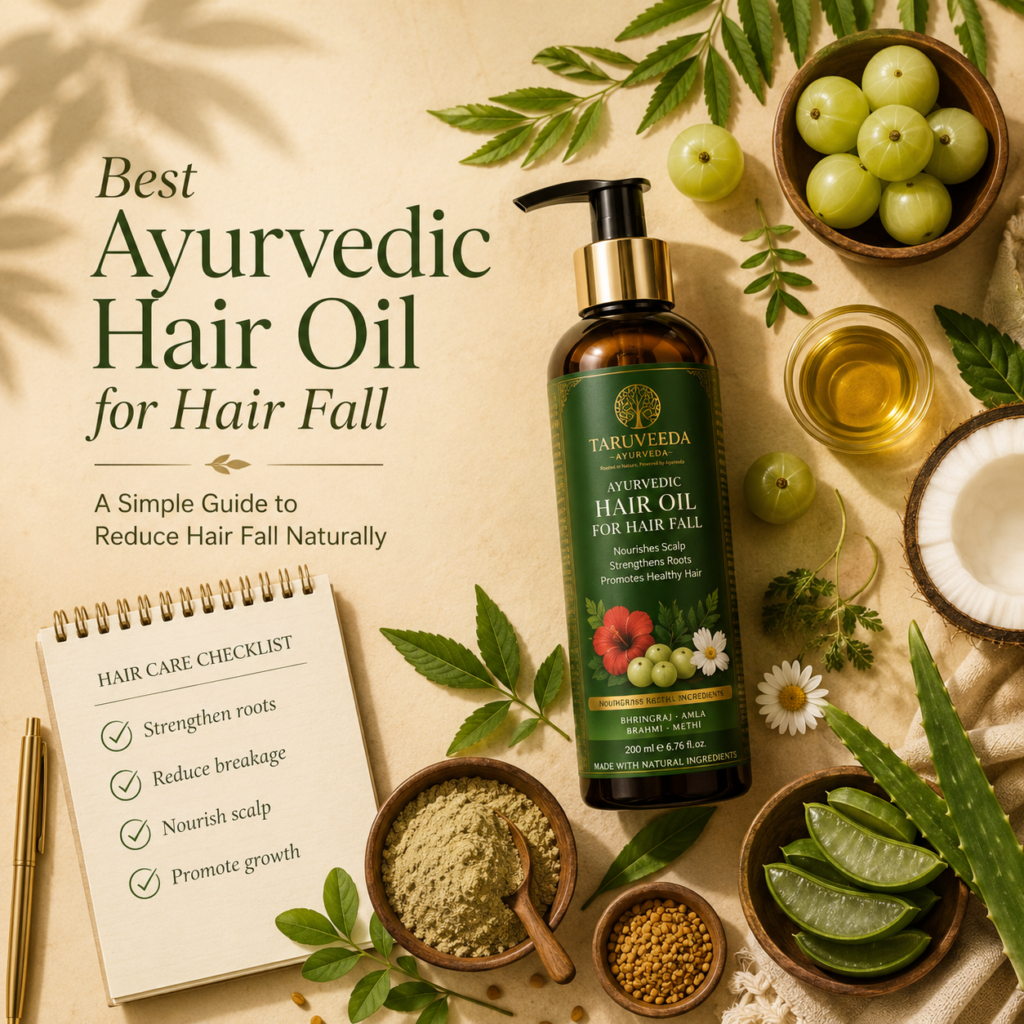
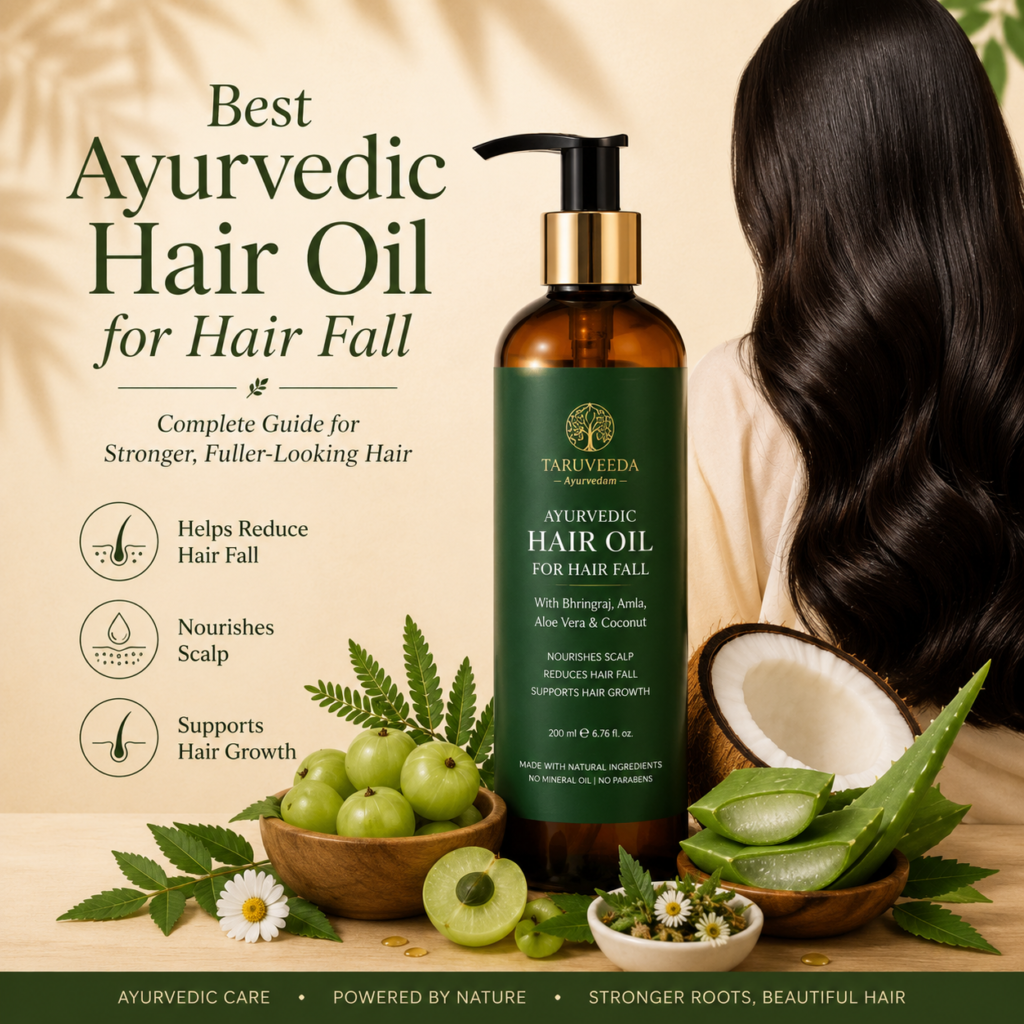
Hair fall is one of the most common hair concerns in India. Some people notice extra hair on the pillow, some see more strands during shampooing, and some feel their hair volume is slowly reducing. This is why many people search for an ayurvedic hair oil for hair fall or a natural oil that can support stronger roots and healthier-looking hair.
But hair fall should be understood properly. Losing some hair every day is normal. Mayo Clinic notes that people typically shed around 50 to 100 hairs a day, and this is usually not noticeable because new hair grows at the same time. Hair loss becomes a concern when new hair does not replace the hair that has fallen out. Common causes include heredity, hormonal changes, medical conditions, stress, certain medicines, and poor nutrition. (Mayo Clinic)
This means hair oil can support scalp care and reduce breakage-related hair fall, but it should not be treated as a magic cure for every type of hair loss. A good Ayurvedic oil works best when used consistently, along with better diet, sleep, stress control, gentle washing, and proper scalp care.
If you are looking for a natural herbal oil for regular use, Taruveeda Ayurvedic Hair Oil can be added to your weekly hair care routine to support scalp nourishment and stronger-looking roots.
Why Hair Fall Happens
Hair fall can happen for many reasons. Some are temporary and improve with time. Others may need medical treatment.
The first thing to understand is the difference between hair shedding, hair breakage, and hair loss.
Hair Shedding
This happens when hair falls from the root as part of the natural hair cycle. Some shedding is normal. It becomes noticeable when the amount increases suddenly or continues for weeks.
Hair Breakage
This happens when the hair strand breaks from the middle or ends. It may look like hair fall, but the root is not falling out. Breakage is common in dry, rough, chemically treated, heat-styled, or tightly tied hair.
Hair Loss
This happens when the hair becomes thinner, bald patches appear, or new hair does not grow properly after shedding. This may be linked to genetics, hormones, scalp disease, thyroid problems, nutritional deficiencies, stress, or autoimmune conditions.
Medical references explain that hair loss may be linked with heredity, hormonal changes, thyroid issues, pregnancy, menopause, scalp infections, stress, poor nutrition, and some medical conditions. (Mayo Clinic)
Common reasons for hair fall include:
- Stress and poor sleep
- Low protein intake
- Iron or vitamin deficiency
- Hormonal changes
- Thyroid imbalance
- Post-pregnancy shedding
- Dandruff or scalp irritation
- Harsh shampooing
- Heat styling
- Chemical treatments
- Tight hairstyles
- Poor scalp hygiene
- Genetics
This is why the best routine for hair fall should not depend only on oil. Oil can support the scalp and hair shaft, but the reason behind hair fall should also be checked.
For a broader hair care routine, you can also explore Ayurvedic hair products that support regular scalp and hair maintenance.
Can Ayurvedic Hair Oil Help With Hair Fall?
Yes, Ayurvedic hair oil can help in some hair fall situations, especially when the problem is linked to dryness, weak hair length, poor scalp care, rough handling, or breakage. It can also make the scalp massage routine more consistent.
However, it is important to keep the claim realistic. An ayurvedic oil for hair fall may support hair and scalp health, but it cannot reverse all types of hair loss, especially genetic hair thinning, severe hormonal hair loss, alopecia areata, scalp infection, or medical-condition-related hair fall.
Ayurvedic hair oil may help by:
- Nourishing the scalp
- Reducing dryness
- Supporting gentle scalp massage
- Improving hair softness
- Reducing friction before washing
- Helping protect the hair shaft
- Supporting root comfort
- Making hair more manageable
- Reducing breakage-related fall
Many people search for anti-hair fall oils because they want a natural routine before moving to stronger clinical treatments. This is where herbal and Ayurvedic oiling can be useful as a regular care step.
A study on rosemary oil and 2% minoxidil in androgenetic alopecia followed patients for 6 months and found improvement in both groups at the 6-month stage. This does not mean every herbal oil gives the same result, but it shows why plant-based oils are being studied for hair concerns. (PubMed)
For users who prefer a traditional Indian hair care routine, Taruveeda Ayurvedic Hair Oil can be used before wash days to support scalp nourishment and stronger-looking hair.
Best Ayurvedic Herbs for Hair Loss and Weak Roots
Ayurvedic hair oils are mainly judged by their herbs. The right herbs can support the scalp, reduce dryness, improve texture, and make the hair feel stronger over time.
Below are some commonly used ayurvedic herbs for hair loss and weak roots.
1. Bhringraj
Bhringraj is one of the most respected herbs in Ayurvedic hair care. It is traditionally used in hair oils for scalp nourishment, root strength, and healthier-looking hair.
Preclinical research has studied Eclipta alba, commonly known as Bhringraj, for hair growth activity. These studies are early and not the same as large human clinical trials, but they help explain why Bhringraj remains widely used in Ayurvedic hair oil formulations.
Bhringraj is often suitable for people dealing with:
- Weak roots
- Dry scalp
- Hair thinning concerns
- Rough hair texture
- Traditional hair fall care
2. Amla
Amla is widely used in Indian hair care because it is associated with hair strength, shine, and scalp nourishment. It is used in oils, powders, shampoos, and hair masks.
Amla is often added to anti-hair fall oils because it supports hair quality and helps improve the look and feel of dull hair.
Amla may be useful for:
- Dull hair
- Weak hair strands
- Roughness
- Hair breakage
- Scalp nourishment
3. Brahmi
Brahmi is commonly used in Ayurvedic formulations for scalp cooling and relaxation. It is often selected when the hair care routine is also focused on stress-related scalp tension and regular massage.
Brahmi is traditionally used for:
- Scalp comfort
- Cooling effect
- Root nourishment
- Stress-related hair care routines
4. Neem
Neem is mainly a scalp-care herb. It is useful in formulations made for itchy, oily, or dandruff-prone scalps. Since scalp imbalance can worsen hair fall for some people, neem-based hair care may be helpful as part of a broader routine.
Neem is commonly used for:
- Scalp freshness
- Itchy scalp support
- Dandruff-prone scalp care
- Oil-control routines
5. Methi
Methi, or fenugreek, is a popular home remedy ingredient in India. It is used in hair masks and oils for softness, texture, and hair conditioning.
Methi may support:
- Dry hair
- Rough hair
- Breakage-prone strands
- Hair softness
6. Curry Leaves
Curry leaves are traditionally used in oil preparations for hair nourishment. Many Indian households use curry leaves with coconut oil for hair strength and shine.
Curry leaves are commonly associated with:
- Hair nourishment
- Better texture
- Traditional oiling routines
- Weak hair care
7. Rosemary
Rosemary has become popular in modern natural hair care. Research has studied rosemary oil in androgenetic alopecia, but it should still be used with realistic expectations and proper dilution. (PubMed)
Rosemary may be useful in formulations focused on:
- Scalp stimulation
- Hair thinning concerns
- Natural hair care routines
- Scalp massage
Hair Oiling Routine for Hair Fall Control
The way you use oil matters. Many people apply too much oil, massage too hard, leave it overnight even when their scalp is uncomfortable, and then use strong shampoo repeatedly to remove it. This can make the scalp irritated and the hair drier.
A better routine is simple and consistent.
Step 1: Start With Dry, Detangled Hair
Before applying oil, gently detangle your hair using fingers or a wide-tooth comb. Do not oil tangled hair because it can increase breakage during massage.
Step 2: Use a Small Quantity First
Take a small amount of oil. You do not need to soak the scalp completely. Too much oil does not mean faster results.
For short hair, use a smaller amount.
For long hair, apply mainly to the scalp first and then lightly to the length.
Step 3: Apply Oil in Sections
Part your hair into sections and apply oil directly on the scalp. Focus on the crown, sides, back of the head, and hairline area.
Step 4: Massage Gently for 5–10 Minutes
Use fingertips, not nails. Massage in circular movements. Do not rub aggressively. Harsh massage can pull weak hair and increase breakage.
Step 5: Apply Lightly on Hair Length
If your hair fall is actually breakage, the length also needs care. Apply a small amount of oil to the mid-length and ends to reduce dryness and friction.
Step 6: Leave It for 1–3 Hours
For most people, 1 to 3 hours is enough. Overnight oiling is not compulsory.
Avoid overnight oiling if:
- Your scalp is oily
- You have dandruff
- Your scalp becomes itchy
- You get acne on the forehead or scalp
- Your hair feels too greasy after washing
Step 7: Wash With a Gentle Shampoo
Use a mild shampoo. Do not wash three or four times just to remove oil. If you need too much shampoo, you are probably applying too much oil.
You can pair oiling with Taruveeda Herbal Shampoo for a gentler hair care routine.
Step 8: Repeat 2–3 Times Weekly
Hair fall routines need consistency. Oiling once and expecting instant results is not realistic. Use oil regularly for several weeks and track changes in breakage, dryness, scalp comfort, and hair texture.
What to Check Before Buying Anti-Hair Fall Oil
There are many anti-hair fall oils in the market. Some are herbal, some are Ayurvedic, some are customised, and some are heavily advertised. Many people compare customised Ayurvedic oils, anti-hair fall oils, and herbal oils before choosing the right product.
People also search for terms like Vedix anti hair fall oil and Vedix customised anti hair fall oil because they are comparing different types of Ayurvedic hair products. Instead of choosing only by brand name, check whether the product actually suits your scalp, routine, and hair concern.
Here is what to check before buying an anti-hair fall oil.
1. Ingredient Quality
Look for herbs known for scalp and hair support, such as bhringraj, amla, brahmi, neem, methi, curry leaves, or other traditional ingredients.
Avoid buying only because the label says “hair growth” or “anti hair fall.” Read the ingredients.
2. Scalp Suitability
The best oil for dry scalp may not suit oily scalp. If your scalp is sensitive, always do a patch test before regular use.
3. Claims Made by the Brand
Avoid products that promise unrealistic results such as:
- “Stop hair fall in 3 days”
- “Grow hair instantly”
- “Regrow bald patches naturally”
- “100% cure for hair loss”
Hair fall can have medical causes, so such claims are not reliable.
4. Texture and Usability
If an oil is too heavy or sticky, you may stop using it. The best oil is one you can use consistently.
5. Hair Type
Choose according to your hair and scalp condition:
| Hair/Scalp Type | What to Prefer |
| Dry scalp | Nourishing herbal oil |
| Oily scalp | Light application, shorter duration |
| Dandruff-prone scalp | Scalp-friendly herbal oil |
| Long hair | Oil for scalp and length |
| Breakage-prone hair | Conditioning oil before wash |
| Weak roots | Root-nourishing Ayurvedic oil |
6. Complete Routine Compatibility
Hair oil should work with your shampoo, diet, sleep, and styling habits. If you oil properly but use harsh shampoo or heat styling daily, results may be limited.
Taruveeda Hair Oil for Root Strength and Scalp Nourishment
Taruveeda Hair Oil is suitable for people who want a natural Ayurvedic oiling routine for hair fall support, scalp nourishment, and stronger-looking hair.
It is not positioned as a medical treatment for genetic baldness or severe hair loss. Instead, it is best used as a regular hair care product for people who want to support their scalp, reduce dryness, improve texture, and maintain healthier-looking hair.
Taruveeda Ayurvedic Hair Oil can be useful if you are looking for:
- Ayurvedic hair oil for hair fall
- Herbal oil for stronger roots
- Natural scalp nourishment oil
- Pre-wash oil for dry and rough hair
- Hair oil for breakage-prone hair
- Regular oiling support for long hair
- Ayurvedic hair product for weekly care
The best way to use Taruveeda Hair Oil is to apply it 2 to 3 times a week before washing. Massage gently for 5 to 10 minutes, leave it for 1 to 3 hours, and wash with a mild shampoo.
For a complete routine, you can also explore Taruveeda hair care products or pair it with Taruveeda Herbal Shampoo.
When Hair Fall Needs Medical Attention
Ayurvedic oiling can support scalp and hair health, but some signs need expert advice.
You should speak with a dermatologist if you notice:
- Sudden heavy hair fall
- Patchy bald spots
- Scalp pain or burning
- Severe itching or scaling
- Hair fall after illness or medication
- Hair thinning that keeps increasing
- Hair fall after childbirth that feels excessive
- Family history of progressive baldness
- Dandruff that does not improve
- Redness, swelling, or wounds on the scalp
Hair loss can be caused by heredity, hormonal changes, medical conditions, stress, poor nutrition, medications, and scalp infections. In such cases, oiling alone may not solve the root cause. (Mayo Clinic)
Final Thoughts
The best Ayurvedic hair oil for hair fall is not the one with the loudest claim. It is the one that suits your scalp, supports regular use, contains sensible herbal ingredients, and fits into a complete hair care routine.
If your hair fall is linked to dryness, breakage, weak hair care, poor scalp nourishment, or rough handling, an Ayurvedic oiling routine can help support healthier-looking hair over time. Herbs like bhringraj, amla, brahmi, neem, methi, curry leaves, and rosemary have strong traditional value in hair care, and some ingredients have also been studied in early scientific research.
For people looking for a natural ayurvedic oil for hair fall, Taruveeda Ayurvedic Hair Oil can be a practical choice for weekly scalp nourishment and root-strengthening support.
Use it consistently, massage gently, avoid harsh washing, and give your hair time. Hair fall control is not about one shortcut. It is about building a routine that supports the scalp, roots, and hair length together.
FAQs About Ayurvedic Oil for Hair Fall
1. Which Ayurvedic hair oil is best for hair fall?
The best Ayurvedic hair oil for hair fall should support scalp nourishment, root strength, and hair shaft protection. Look for herbal ingredients such as bhringraj, amla, brahmi, neem, methi, curry leaves, or other traditional herbs. Taruveeda Ayurvedic Hair Oil is suitable for people who want a natural weekly oiling routine for stronger-looking hair.
2. Can Ayurvedic oil stop hair fall completely?
Ayurvedic oil may help reduce hair fall caused by dryness, breakage, poor scalp care, or rough handling. However, it may not stop hair fall caused by genetics, hormones, thyroid issues, illness, medication, or scalp disease. If hair fall is sudden or severe, consult a dermatologist.
3. How often should I use Ayurvedic hair oil for hair fall?
Most people can use Ayurvedic hair oil 2 to 3 times a week. If your scalp is oily or dandruff-prone, use less oil and keep it for a shorter time. If your hair is dry, you can apply it to both scalp and hair length.
4. Can I leave anti-hair fall oil overnight?
You can leave oil overnight if your scalp feels comfortable. But overnight oiling is not necessary for everyone. For many people, 1 to 3 hours before washing is enough. If overnight oiling causes itching, dandruff, heaviness, or acne, reduce the duration.
5. What are the best Ayurvedic herbs for hair loss?
Common Ayurvedic herbs used for hair loss and weak roots include bhringraj, amla, brahmi, neem, methi, curry leaves, hibiscus, and rosemary. These herbs are traditionally used for scalp nourishment, hair strength, and better texture.
6. Is hair fall always a serious problem?
No. Some daily shedding is normal. Mayo Clinic notes that people commonly shed around 50 to 100 hairs per day. Hair fall becomes a concern when shedding increases suddenly, thinning becomes visible, bald patches appear, or new hair does not replace fallen hair. (Mayo Clinic)
7. Is Taruveeda Hair Oil suitable for hair fall?
Yes, Taruveeda Ayurvedic Hair Oil is suitable for people looking for a natural oiling routine to support scalp nourishment, root strength, and healthier-looking hair. It is best used 2 to 3 times a week before washing.
8. How long does Ayurvedic hair oil take to show results?
Softness and manageability may improve after a few uses. For visible improvement in breakage, dryness, and hair quality, use consistently for at least 8 to 12 weeks. Hair growth is slow, so patience is important.