
Herbal hair oil has always had a strong place in Indian hair care. Long before modern serums, sprays, and styling creams became common, many households used oiling as a weekly routine for scalp nourishment, hair softness, and long-hair maintenance.
Today, people search for terms like ayurvedic herbal hair oil, herbal ayurvedic hair oil, natural adivasi herbal hair oil, Khadi ayurvedic hair oil, Muuchstac hair oil, and other herbal oil brands because they want a more traditional, plant-based solution for hair fall, dryness, weak roots, and rough hair.
But every herbal hair oil is not the same. Some are genuinely made with useful herbs and good carrier oils. Others are mainly mineral oil, fragrance, and marketing claims. The right choice depends on your scalp type, hair concern, ingredients, and how consistently you can use the oil.
A good herbal oil cannot cure every type of hair loss, but it can support scalp care, reduce dryness, improve hair texture, and help protect the hair length from breakage. Johns Hopkins Medicine notes that most people naturally shed around 50 to 100 hairs daily, and scalp hair grows about half an inch per month on average. So, hair care should be judged over weeks and months, not after one or two applications. (Johns Hopkins Medicine)
If you want a natural Ayurvedic oiling routine for stronger-looking, smoother, and healthier hair, Taruveeda Ayurvedic Hair Oil can be used as a regular pre-wash scalp and hair nourishment oil.
What Is Herbal Hair Oil?
Herbal hair oil is a hair oil made with plant-based ingredients such as herbs, leaves, roots, seeds, flowers, or botanical extracts. In traditional Indian hair care, these herbs are usually infused into a carrier oil such as coconut oil, sesame oil, castor oil, almond oil, or another nourishing base oil.
A herbal oil may be used for:
- Scalp nourishment
- Dryness control
- Hair softness
- Root support
- Hair breakage reduction
- Better manageability
- Shine and smoothness
- Weekly pre-wash care
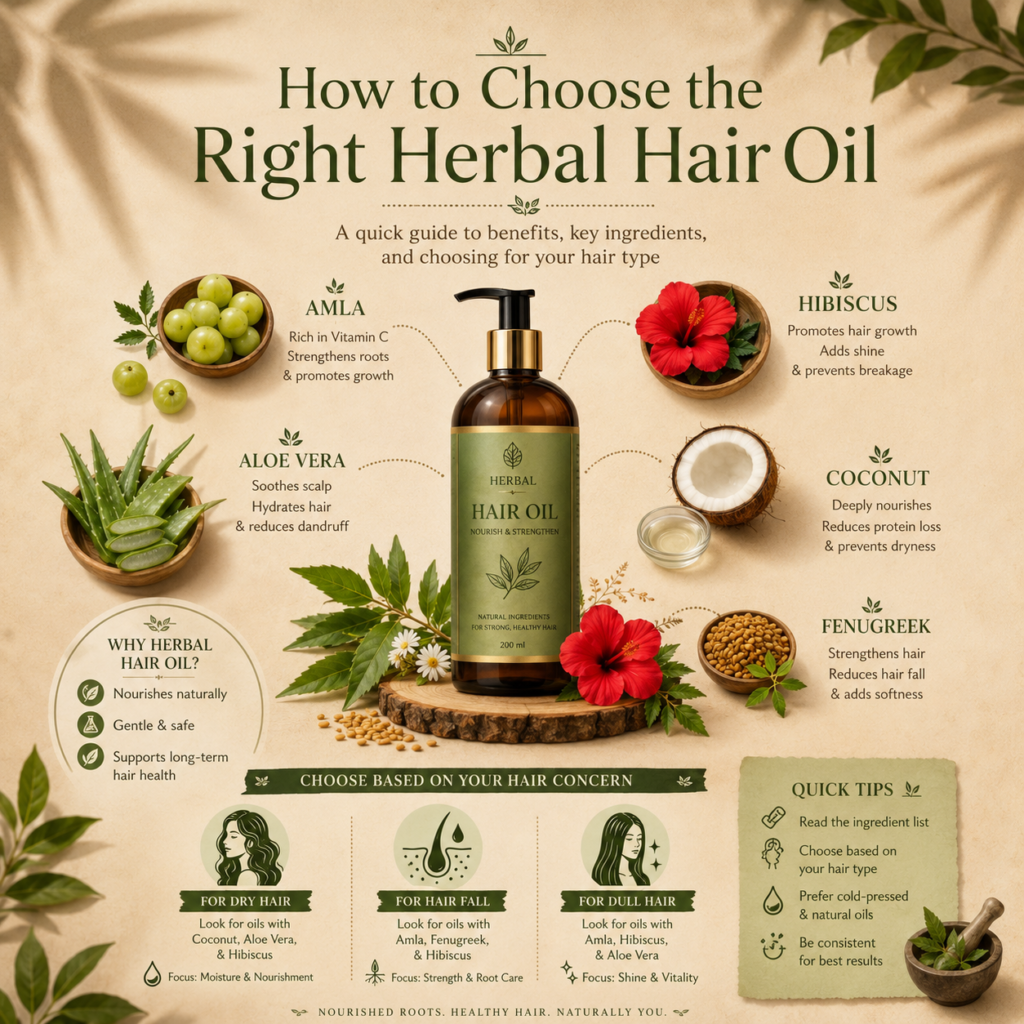
When people search for ayurvedic herbal hair oil, they usually want a product that is more natural, gentle, and rooted in traditional hair care. Ayurvedic hair oils typically use herbs known in Ayurveda for scalp and hair support, such as bhringraj, amla, brahmi, neem, hibiscus, methi, and curry leaves.
The term natural adivasi herbal hair oil is also searched often. This usually shows that users are interested in traditional, forest-herb-inspired, or indigenous-style hair care. However, brands should use this term carefully. Unless a product is genuinely made using a specific Adivasi traditional formulation or community source, it is better to describe it honestly as herbal, Ayurvedic, natural, or traditional rather than making unsupported cultural claims.
For a complete herbal routine, you can also explore Taruveeda hair care products.
Difference Between Herbal Hair Oil and Regular Hair Oil
The main difference is the formulation intent. A regular hair oil may simply coat the hair and add shine. A good herbal hair oil is usually designed to support scalp and hair health through herbs and nourishing oils.
| Factor | Regular Hair Oil | Herbal / Ayurvedic Hair Oil |
| Main purpose | Shine, styling, smoothness | Scalp nourishment and hair care |
| Ingredients | May contain mineral oil, fragrance, silicones | Herbs, botanical extracts, natural oils |
| Routine use | Often cosmetic | Often pre-wash scalp and hair care |
| Traditional value | Usually low | Strong in Indian and Ayurvedic care |
| Best for | Quick softness and shine | Dryness, roughness, weak roots, scalp care |
| Buying check | Texture and fragrance | Herbs, base oil, scalp suitability, claims |
A regular oil may make hair look shiny for a short time, but it may not offer the same herbal scalp-care value. A herbal Ayurvedic oil is usually better for people who want long-term maintenance rather than only instant cosmetic shine.
That said, “herbal” on a label does not automatically mean the product is high quality. You still need to check the ingredient list, oil base, fragrance level, brand transparency, and whether the claims are realistic.
Common Herbs Used in Ayurvedic Hair Oils
A strong herbal hair oil depends on its ingredients. Below are common herbs used in Ayurvedic and herbal hair oils, along with their traditional role in hair care.
1. Bhringraj
Bhringraj, also known as Eclipta alba, is one of the best-known Ayurvedic herbs for hair. It is traditionally used in oils for scalp nourishment, weak roots, and healthier-looking hair.
Research on Eclipta alba has explored its hair growth-promoting activity in animal models. One PubMed-indexed study reported that extracts of Eclipta alba showed hair-growth activity in albino rats, while another study reported dose-dependent activity in mice. These are preclinical studies, not large human clinical trials, so the claims should remain balanced. (PubMed)
Bhringraj is commonly used for:
- Weak roots
- Scalp nourishment
- Traditional hair growth oils
- Dry and rough hair routines
- Hair fall support routines
2. Amla
Amla is widely used in Indian hair care because it is associated with strength, shine, and scalp support. It appears in many Ayurvedic oils, shampoos, powders, and hair masks.
Amla is commonly used for:
- Dull hair
- Dry hair
- Weak-looking strands
- Hair shine
- Scalp nourishment
Amla is especially useful in blogs and product content because it has strong public recognition. Many users already associate amla with Indian hair care, so it helps build trust when included honestly in the formulation story.
3. Brahmi
Brahmi is often used in Ayurvedic hair oils for scalp comfort, cooling, and relaxation. It is commonly found in traditional oils that focus on stress-related scalp care and gentle massage routines.
Brahmi is commonly used for:
- Scalp cooling
- Relaxation during massage
- Root nourishment
- Dry scalp routines
4. Neem
Neem is mostly known as a scalp-care herb. It is often used where the scalp feels oily, itchy, or dandruff-prone.
Neem is commonly used for:
- Scalp freshness
- Itchy scalp care
- Dandruff-prone scalp routines
- Oil balance support
If someone has severe dandruff, redness, scaling, or scalp infection, they should consult a dermatologist instead of depending only on oil.
5. Methi
Methi, or fenugreek, is a common Indian home remedy ingredient. It is often used in hair masks and oils for softness and conditioning.
Methi is commonly used for:
- Rough hair
- Dryness
- Frizz
- Breakage-prone strands
- Hair softness
6. Hibiscus
Hibiscus is traditionally used in Indian hair packs and oils. It is often associated with hair softness, shine, and conditioning.
Hibiscus is commonly used for:
- Hair texture
- Smoothness
- Shine
- Dry hair care
7. Curry Leaves
Curry leaves are often used in homemade hair oils. They are traditionally associated with hair nourishment and strength.
Curry leaves are commonly used for:
- Traditional oiling routines
- Hair nourishment
- Weak hair care
- Shine and texture
8. Rosemary
Rosemary oil has become popular in modern herbal hair care. A randomized trial compared rosemary oil with 2% minoxidil for androgenetic alopecia over 6 months and found improvement in both groups at the 6-month point. This does not mean rosemary oil is a guaranteed hair-loss treatment, but it explains why rosemary is now discussed seriously in natural hair care. (PubMed)
Rosemary must be used properly, especially if it is an essential oil. It should generally be diluted and patch-tested to avoid irritation.
Why Natural Herbal Hair Oils Are Popular in India
Herbal oils are popular in India because they fit naturally into everyday family hair care habits. Oiling is not new here. It is part of many people’s childhood routine, especially before hair wash days.
The popularity of herbal oils comes from several reasons.
1. Traditional Trust
People trust ingredients they have seen in family routines: amla, bhringraj, coconut oil, neem, methi, hibiscus, and curry leaves. This makes herbal oil feel familiar and safe.
2. Scalp and Hair Comfort
Many users do not want only fragrance or shine. They want oil that feels nourishing on the scalp and makes hair softer after washing.
3. Concern About Hair Fall
Hair fall is a high-anxiety topic. Users often start with herbal oils before considering clinical products. This is why searches for ayurvedic herbal hair oil, ayurvedic oil for hair fall, and herbal hair oil for growth remain strong.
4. Interest in Natural Products
Consumers are increasingly checking ingredients. Many prefer plant-based products, especially for regular-use categories like hair oil, shampoo, and skincare.
5. Comparison Shopping
People also compare brands before buying. Searches like Khadi ayurvedic hair oil, Muuchstac hair oil, Sneha adivasi herbal hair oil, and similar brand-led queries show that users are not only looking for education; they are also comparing options.
This is where Taruveeda should position itself clearly: not with exaggerated claims, but with honest Ayurvedic hair care, ingredient clarity, and regular-use suitability.
How to Identify a Good Herbal Hair Oil
A good herbal hair oil should be judged by ingredients, scalp suitability, usage comfort, and realistic claims. Do not buy only because the packaging says “herbal,” “natural,” or “Ayurvedic.”
Use this checklist before buying.
1. Check the Ingredient List
Look for real herbs and a suitable carrier oil. Good herbal oils often include ingredients such as:
- Bhringraj
- Amla
- Brahmi
- Neem
- Hibiscus
- Methi
- Curry leaves
- Sesame oil
- Coconut oil
- Castor oil
- Almond oil
Avoid products where the ingredient story is unclear or where the product is mainly fragrance with little herbal value.
2. Match the Oil With Your Scalp Type
Different scalps need different usage patterns.
| Scalp / Hair Type | Best Approach |
| Dry scalp | Nourishing oil, 2–3 times weekly |
| Oily scalp | Small quantity, shorter duration |
| Dandruff-prone scalp | Avoid overnight oiling if flakes increase |
| Sensitive scalp | Patch test before use |
| Long hair | Apply to scalp and lightly to length |
| Breakage-prone hair | Use as pre-wash protection |
3. Avoid Unrealistic Claims
Be careful with claims like:
- “Grow hair in 7 days”
- “Stop all hair fall permanently”
- “Regrow bald patches naturally”
- “100% guaranteed hair growth”
- “Cure genetic baldness”
Hair loss can be caused by genetics, hormones, illness, scalp conditions, medication, stress, nutritional deficiency, and tight hairstyles. Johns Hopkins Medicine lists factors such as illness, hormones, family history, protein or iron deficiency, rapid weight loss, and autoimmune disease among possible causes of hair loss. (Johns Hopkins Medicine)
So, a good herbal oil should make supportive hair-care claims, not medical-cure claims.
4. Check Texture and Washability
An oil should be comfortable enough for regular use. If it is too sticky, too heavy, or too difficult to wash, people stop using it.
For regular use, choose an oil that:
- Spreads easily
- Does not feel overly sticky
- Can be washed with mild shampoo
- Does not make the scalp itchy
- Does not leave the hair excessively greasy
5. Patch Test Before Regular Use
Even natural products can irritate some people. Apply a small amount behind the ear or on a small scalp area first. Wait 24 hours. If there is itching, burning, redness, or irritation, do not continue.
6. See Whether It Fits Your Routine
The best oil is the one you can use consistently. A practical routine is usually better than an overcomplicated one.
For most people:
- Use oil 2–3 times weekly
- Massage gently for 5–10 minutes
- Leave for 1–3 hours
- Wash with mild shampoo
- Avoid harsh brushing after oiling
- Avoid tight hairstyles
Tight hairstyles and constant pulling can contribute to traction-related hair loss, so gentle styling also matters. (The Times of India)
Taruveeda Herbal Hair Oil: A Natural Ayurvedic Option
Taruveeda Herbal Hair Oil is suitable for people who want a natural Ayurvedic oiling routine for scalp nourishment, stronger-looking hair, and better long-hair maintenance.
It is best positioned as a regular hair care oil, not as a medical treatment for baldness or severe hair loss. This is important for trust. Customers are more likely to believe a brand that explains realistic benefits instead of promising overnight results.
Taruveeda Ayurvedic Hair Oil can be a good option if you are looking for:
- Ayurvedic herbal hair oil
- Herbal Ayurvedic hair oil for regular use
- Natural oil for scalp nourishment
- Pre-wash oil for dry and rough hair
- Hair oil for stronger-looking roots
- Herbal oil for long hair maintenance
- Ayurvedic hair product for weekly routine
For best results, use Taruveeda Hair Oil 2 to 3 times a week before washing. Apply it to the scalp in sections, massage gently for 5 to 10 minutes, apply a small amount to the hair length, leave it for 1 to 3 hours, and wash with a mild shampoo.
For a complete routine, you can pair it with Taruveeda Herbal Shampoo and explore more Ayurvedic hair products.
Final Thoughts
The best herbal hair oil is not simply the one with the most herbs or the strongest claim. It should suit your scalp, use sensible ingredients, feel comfortable, and support a routine you can follow consistently.
People searching for natural adivasi herbal hair oil, Khadi ayurvedic hair oil, Muuchstac hair oil, or other herbal oil options are usually looking for trust, tradition, and visible hair care support. Taruveeda can compete in this space by being clear, natural, practical, and realistic.
A good herbal Ayurvedic oil can support scalp nourishment, reduce dryness, improve softness, protect hair length from breakage, and make the hair feel healthier over time. But for sudden, severe, patchy, or medical hair loss, professional diagnosis is still important.
If you want a natural Ayurvedic oiling routine for stronger-looking, smoother, and healthier hair, Taruveeda Ayurvedic Hair Oil is a practical choice for weekly scalp and hair nourishment.
FAQs About Herbal Hair Oil
1. What is herbal hair oil?
Herbal hair oil is a hair oil made with plant-based ingredients such as herbs, leaves, roots, seeds, flowers, or botanical extracts. It is usually used for scalp nourishment, hair softness, dryness control, and breakage reduction.
2. Is Ayurvedic herbal hair oil good for hair growth?
Ayurvedic herbal hair oil can support healthier-looking hair by nourishing the scalp, reducing dryness, improving manageability, and helping protect hair length from breakage. It cannot guarantee new hair growth in every case, especially if hair loss is due to genetics, hormones, illness, or scalp disease.
3. Which herbs are commonly used in Ayurvedic hair oils?
Common herbs include bhringraj, amla, brahmi, neem, methi, hibiscus, curry leaves, and rosemary. These herbs are traditionally used for scalp support, hair strength, softness, and better texture.
4. Is natural adivasi herbal hair oil different from Ayurvedic hair oil?
Not always. People often use the term natural adivasi herbal hair oil when looking for traditional, herb-based hair care. Ayurvedic hair oil is based on Ayurvedic principles and herbs. A product should only be called Adivasi hair oil if it genuinely follows that specific traditional source or formulation.
5. How often should I use herbal hair oil?
Most people can use herbal hair oil 2 to 3 times a week. If your scalp is oily, use less oil and leave it for a shorter time. If your hair is dry or long, apply lightly to the hair length as well.
6. Can herbal hair oil reduce hair fall?
Herbal hair oil may help reduce hair fall caused by dryness, breakage, poor scalp care, or rough handling. It may not stop hair fall caused by genetics, hormonal imbalance, thyroid issues, illness, nutritional deficiency, or scalp infection.
7. How do I choose the best herbal hair oil?
Choose a herbal hair oil based on ingredient quality, scalp type, texture, washability, brand transparency, and realistic claims. Avoid oils that promise instant hair growth or permanent hair fall cure.
8. Is Taruveeda Hair Oil a herbal Ayurvedic hair oil?
Yes, Taruveeda Hair Oil can be positioned as a herbal Ayurvedic hair oil for regular scalp nourishment, stronger-looking hair, and better hair maintenance. It is suitable for users looking for a natural oiling routine.