
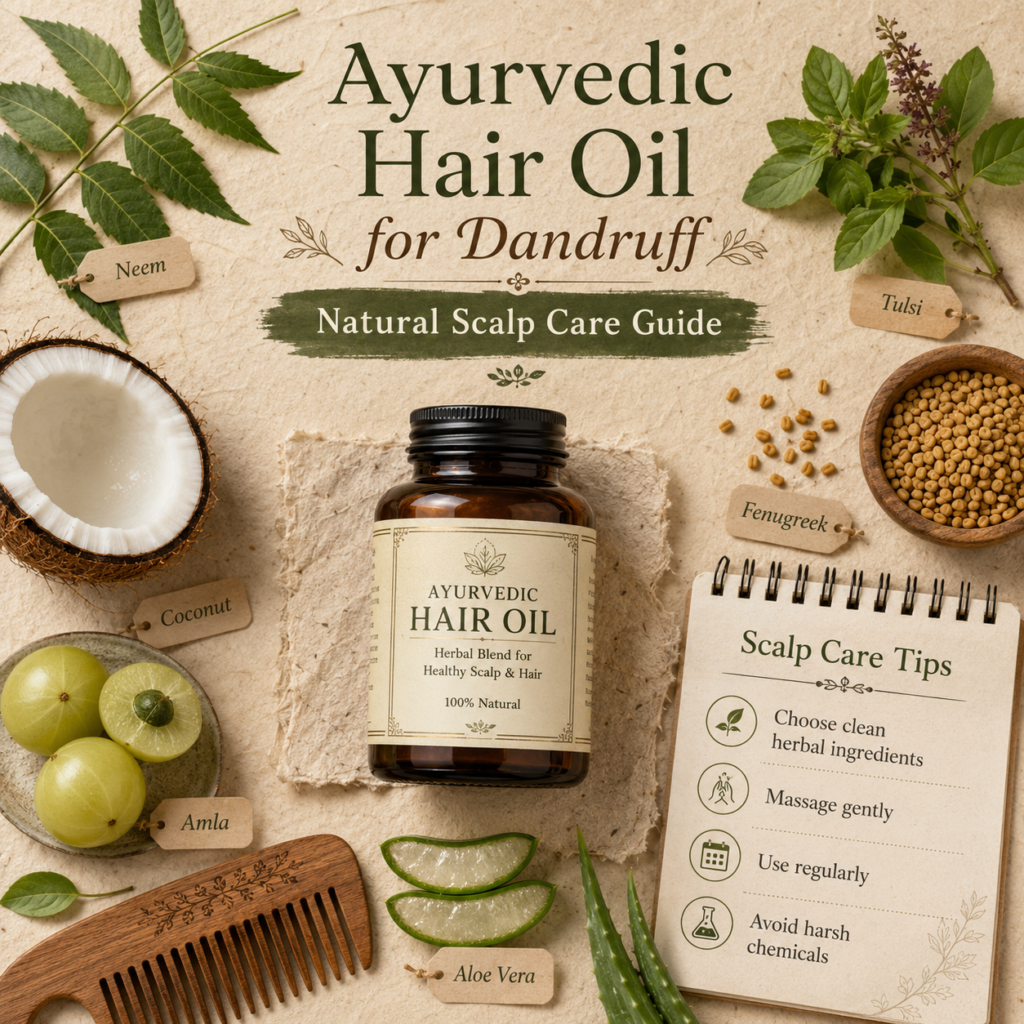
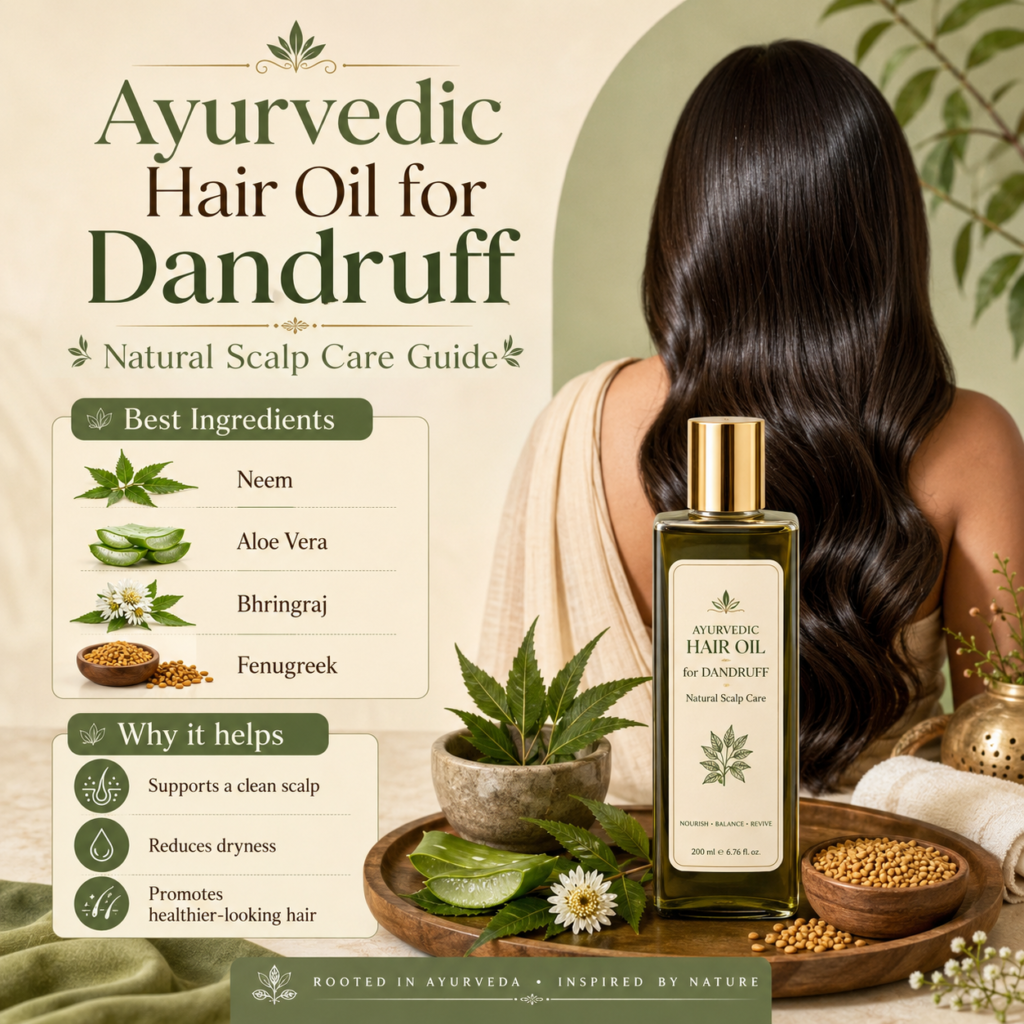
Dandruff is one of the most common scalp concerns. For some people, it appears as small white flakes on the shoulders. For others, it comes with itching, dryness, greasiness, or repeated scalp irritation. This is why many people search for an ayurvedic hair oil for dandruff or an ayurvedic scalp oil that can support a cleaner, calmer scalp.
But dandruff needs to be understood correctly. It is not always caused by “dryness” alone, and it is not always solved by applying more oil. Mayo Clinic describes dandruff as a common condition that causes scalp flaking and notes that it may be linked with irritated oily skin, dry skin, Malassezia fungus, sensitivity to hair care products, psoriasis, eczema, and seborrheic dermatitis. (Mayo Clinic)
A good Ayurvedic oil can support scalp nourishment, reduce dryness, and improve comfort when used correctly. However, if dandruff is severe, greasy, red, painful, or persistent, medicated dandruff shampoo or dermatologist care may be needed. The American Academy of Dermatology says mild dandruff can often be managed at home with regular washing and dandruff shampoos containing ingredients such as zinc pyrithione, salicylic acid, sulfur, selenium sulfide, ketoconazole, or coal tar. (American Academy of Dermatology)
For regular scalp nourishment, Taruveeda Ayurvedic Hair Oil can be used carefully as part of a pre-wash routine, especially when the scalp feels dry, rough, or undernourished.
Why Dandruff Happens
Dandruff is not just “white powder on the scalp.” It is a scalp condition where skin cells shed more visibly than usual. It may come and go, and for many people it becomes worse during stress, weather changes, or poor scalp care.
Common causes and triggers include:
- Dry scalp
- Irritated oily scalp
- Malassezia yeast
- Seborrheic dermatitis
- Sensitivity to hair products
- Shampoo residue
- Harsh hair products
- Infrequent washing
- Cold and dry weather
- Stress
- Psoriasis or eczema
- Scalp buildup
Mayo Clinic notes that dandruff is considered a mild form of seborrheic dermatitis and may get worse during stress or cold, dry weather. (Mayo Clinic)
The American Academy of Dermatology also explains that dandruff can develop due to multiple reasons, including medical conditions, oily skin, and hair care habits. (American Academy of Dermatology)
Dry Dandruff vs Oily Dandruff
Not all flakes are the same.
| Type | Common Signs | What Usually Helps |
| Dry scalp flakes | Small, dry, white flakes; scalp may feel tight | Gentle oiling, mild shampoo, less harsh washing |
| Oily dandruff | Greasy flakes, itchiness, scalp buildup | Regular cleansing, dandruff shampoo, avoid heavy oiling |
| Seborrheic dermatitis | Greasy yellowish scales, redness, itching, recurring flare-ups | Dermatologist-guided dandruff shampoo or medication |
| Product buildup | Flakes after styling products or poor rinsing | Better rinsing, clarifying wash, reduce product load |
This difference matters. If the scalp is dry, oiling may help. If the scalp is oily, inflamed, or yeast-prone, heavy oiling can sometimes make things worse.
Can Hair Oil Help With Dandruff?
Yes, hair oil can help in some dandruff-like situations, especially when the flakes are linked with scalp dryness, roughness, and poor scalp nourishment.
But hair oil is not the right solution for every type of dandruff.
An ayurvedic hair oil for dandruff may help when:
- The scalp feels dry and tight
- Flakes are small and dry
- Hair feels rough after washing
- Scalp becomes uncomfortable due to harsh shampoo
- Hair length is dry and frizzy
- You need a pre-wash nourishment routine
Hair oil may not be enough when:
- Flakes are greasy and yellowish
- Scalp is red, painful, or swollen
- Itching is severe
- Dandruff keeps returning quickly
- There is scalp infection or wounds
- Flakes spread to eyebrows, beard, ears, or face
- Medicated treatment has been advised
The American Academy of Dermatology notes that seborrheic dermatitis can appear on oily areas such as the scalp, forehead, eyebrows, eyelids, ears, sides of the nose, beard area, neck, and chest. (American Academy of Dermatology) If flakes are not limited to the scalp, it is better to take the condition seriously.
Practical Rule
Use oil as a supportive scalp-care step, not as a replacement for dandruff treatment.
If your dandruff is mild and dryness-related, oiling before wash may help. If your dandruff is oily, itchy, recurring, or severe, first control the dandruff with the right shampoo or dermatologist advice, then use oil cautiously for nourishment.
Best Ayurvedic Herbs for Scalp Care
Ayurvedic and herbal oils often use herbs that support scalp comfort, nourishment, and cleanliness. These herbs should be discussed responsibly. They may support scalp care, but they should not be described as a guaranteed cure for dandruff or hair loss.
Below are commonly used ayurvedic herbs for scalp care and hair maintenance.
1. Neem
Neem is one of the most recognised scalp-care herbs in Indian hair care. It is commonly used in traditional routines for itchy, oily, or dandruff-prone scalp care.
Neem is often associated with:
- Scalp freshness
- Itch-prone scalp care
- Oily scalp support
- Herbal cleansing routines
- Traditional dandruff-care oils
Neem can be useful in herbal formulations, but if the scalp is inflamed, infected, or painful, medical treatment is more appropriate.
2. Bhringraj
Bhringraj is widely used in Ayurvedic hair oils for scalp nourishment and stronger-looking hair. People often associate it with hair fall support and root care.
Research has studied Eclipta alba, commonly known as bhringraj, for hair growth-promoting activity in animal models. This supports traditional interest in the herb, but it should not be overstated as direct proof of human hair regrowth from oil use.
Bhringraj is commonly used for:
- Scalp nourishment
- Weak root care
- Hair fall support routines
- Dry scalp oiling
- Traditional hair maintenance
3. Amla
Amla is used in many Ayurvedic hair oils because of its strong association with hair strength, shine, and scalp nourishment.
Amla is commonly used for:
- Dull hair
- Dryness
- Hair texture
- Scalp nourishment
- Long-hair maintenance
4. Brahmi
Brahmi is often used in scalp oils for cooling, calming, and gentle massage. It suits routines where scalp comfort and relaxation are important.
Brahmi is commonly used for:
- Scalp comfort
- Cooling massage
- Stress-related scalp care
- Dry scalp routines
5. Methi
Methi, or fenugreek, is a familiar Indian home-care ingredient. It is often used in hair masks and oils for conditioning and texture support.
Methi is commonly used for:
- Rough hair
- Dryness
- Frizz
- Breakage-prone hair
- Softness
6. Hibiscus
Hibiscus is used in traditional Indian hair care for softness, smoothness, and conditioning. It is more of a hair texture support ingredient than a dandruff treatment ingredient.
Hibiscus is commonly used for:
- Hair smoothness
- Shine
- Dryness control
- Conditioning
7. Tea Tree or Rosemary in Modern Herbal Hair Care
Some modern herbal scalp oils include essential oils such as tea tree or rosemary. These can feel refreshing, but they must be used carefully and properly diluted. Essential oils can irritate sensitive scalps when used directly or in high concentration.
For a dandruff-prone scalp, patch testing is important.
How to Use Hair Oil on a Dandruff-Prone Scalp
The biggest mistake people make is applying too much oil and leaving it overnight on an already oily, itchy scalp. That can worsen buildup and discomfort for some users.
Use this routine instead.
Step 1: Identify Your Flake Type
Before oiling, check whether your flakes are dry or oily.
- If flakes are dry and scalp feels tight, light oiling may help.
- If flakes are greasy and scalp is itchy, use oil cautiously.
- If there is redness, swelling, pain, or wounds, avoid oiling and seek medical advice.
Step 2: Use a Small Amount of Oil
Do not soak the scalp. Apply a small amount only.
For a dandruff-prone scalp, less is usually better. Heavy oiling can make washing difficult and may increase buildup.
Step 3: Apply in Sections
Part your hair and apply oil directly to the scalp in small sections. Do not pour oil randomly over the head.
Focus on:
- Dry scalp areas
- Flaky patches
- Hairline
- Crown
- Back of scalp
Step 4: Massage Gently
Massage with fingertips for 3 to 5 minutes. Do not scratch with nails. Scratching can irritate the scalp and may make flakes worse.
Step 5: Do Not Leave It Too Long
For dandruff-prone scalp, keep oil for 30 minutes to 2 hours first. Avoid overnight oiling unless you already know your scalp tolerates it well.
Step 6: Wash Properly
Use a mild shampoo or dandruff shampoo depending on your scalp condition. The AAD recommends dandruff shampoos with active ingredients such as zinc pyrithione, salicylic acid, sulfur, selenium sulfide, ketoconazole, or coal tar when regular washing is not enough. (American Academy of Dermatology)
You can use a gentle routine like:
- Taruveeda oil before wash for nourishment
- Dandruff shampoo when flakes are active
- Mild shampoo on non-dandruff wash days
Pairing oil with Taruveeda Herbal Shampoo can work for users with dry scalp and mild flakes, but persistent dandruff may need a medicated shampoo.
Step 7: Repeat Sensibly
Use oil 1 to 2 times weekly if your scalp is dandruff-prone. If your scalp is dry and tolerates oil well, you may increase to 2 to 3 times weekly.
Stop or reduce oiling if:
- Itching increases
- Flakes become greasy
- Scalp feels heavy
- Acne appears on forehead or scalp
- Dandruff worsens after oiling
Mistakes to Avoid When Oiling a Flaky Scalp
A dandruff-prone scalp needs a different approach from a normal dry scalp. Avoid these mistakes.
1. Leaving Oil Overnight Without Testing
Overnight oiling is not suitable for every scalp. If you have oily dandruff or seborrheic dermatitis, long oiling may increase greasiness and buildup.
Start with 30 minutes to 2 hours.
2. Applying Too Much Oil
More oil does not mean better scalp care. Excess oil can trap dirt, sweat, dead skin, and product residue.
3. Scratching the Scalp During Massage
Scratching may give temporary relief, but it can irritate the scalp. Use fingertips only.
4. Using Oil Instead of Dandruff Shampoo
Oil can support nourishment, but it does not replace dandruff shampoo when flakes are active or recurring. AAD guidance recommends dandruff shampoos when regular washing does not relieve dandruff. (American Academy of Dermatology)
5. Ignoring Product Sensitivity
Dandruff-like flaking can sometimes come from sensitivity to hair products. Mayo Clinic lists sensitivity to hair care products, also called contact dermatitis, as one possible cause of dandruff. (Mayo Clinic)
If flakes started after a new shampoo, serum, hair colour, gel, or oil, stop the new product and observe.
6. Not Washing the Scalp Properly
Some people oil regularly but do not clean the scalp properly. This can create buildup. Wash the scalp, not just the hair length.
7. Using Very Hot Water
Hot water can dry and irritate the scalp. Use lukewarm water.
8. Delaying Dermatologist Care
See a dermatologist if dandruff is severe, painful, recurring, or not improving. The AAD notes that a dermatologist can identify whether dandruff is linked to seborrheic dermatitis, psoriasis, fungal scalp infection, eczema, or another condition. (American Academy of Dermatology)
Taruveeda Hair Oil for Scalp Nourishment
Taruveeda Hair Oil can be positioned as a natural Ayurvedic oil for scalp nourishment, dryness support, and regular hair care. It should not be positioned as a guaranteed dandruff cure. That distinction is important for credibility.
Taruveeda Ayurvedic Hair Oil is suitable for people looking for:
- Ayurvedic scalp oil
- Herbal Ayurvedic hair oil
- Natural oil for dry scalp care
- Pre-wash oil for flaky scalp support
- Oil for scalp nourishment
- Hair oil for dry and rough hair
- Herbal oil for stronger-looking roots
- Natural routine alongside gentle cleansing
Who Can Use It?
Taruveeda Hair Oil may suit you if:
- Your scalp feels dry
- Flakes are mild and dryness-related
- Hair feels rough after washing
- You want a pre-wash Ayurvedic oiling routine
- You need scalp nourishment and hair softness
- You prefer herbal hair care products
Who Should Be Careful?
Use cautiously or avoid oiling if:
- Your scalp is very oily
- Flakes are greasy and yellowish
- Scalp is red, painful, or swollen
- You have wounds or infection-like symptoms
- Dandruff worsens after oiling
- You are already using dermatologist-prescribed scalp treatment
Suggested Taruveeda Routine for Dandruff-Prone Scalp
- Apply a small amount of oil to the scalp.
- Massage gently for 3 to 5 minutes.
- Leave for 30 minutes to 2 hours.
- Wash thoroughly with mild shampoo.
- Use once or twice weekly.
- Reduce use if flakes become oily or itching increases.
For a complete routine, explore Taruveeda hair care products and Ayurvedic hair products.
When Dandruff and Hair Fall Happen Together
Many people search for ayurvedic herbs for hair loss because dandruff and hair fall often appear together. Sometimes dandruff causes itching, and repeated scratching can weaken hair shafts or increase breakage. In other cases, dandruff and hair fall may both be symptoms of scalp inflammation, stress, poor health, or harsh hair care.
Do not assume every hair fall case is caused by dandruff.
Hair fall may also be linked with:
- Genetics
- Hormonal changes
- Thyroid imbalance
- Iron or vitamin deficiency
- Postpartum changes
- Stress
- Harsh treatments
- Tight hairstyles
- Scalp conditions
If hair fall is sudden, heavy, patchy, or increasing, consult a dermatologist. Oil and shampoo can support care, but diagnosis matters.
Final Thoughts
The best Ayurvedic hair oil for dandruff is not the one that promises to remove flakes overnight. It is the one that supports scalp comfort, reduces dryness, fits your scalp type, and works alongside proper cleansing.
If your flakes are mild and dryness-related, a small amount of Ayurvedic scalp oil before washing may help nourish the scalp and improve comfort. If your dandruff is oily, itchy, recurring, or linked with redness and greasy scales, use a dandruff shampoo or consult a dermatologist.
Taruveeda Hair Oil is best positioned as a natural Ayurvedic scalp nourishment oil, not a medical dandruff treatment. Used correctly, Taruveeda Ayurvedic Hair Oil can support a healthier scalp care routine, especially for users dealing with dryness, roughness, and mild flaky scalp concerns.
FAQs About Ayurvedic Hair Oil for Dandruff
1. Which Ayurvedic hair oil is good for dandruff?
An Ayurvedic hair oil with scalp-supporting herbs such as neem, bhringraj, amla, brahmi, methi, and hibiscus may help support dry or flaky scalp care. However, if dandruff is oily, itchy, or recurring, a dandruff shampoo or dermatologist advice may be needed.
2. Can hair oil remove dandruff permanently?
No hair oil should claim to remove dandruff permanently. Dandruff can come back and may be linked with oily skin, Malassezia yeast, seborrheic dermatitis, product sensitivity, psoriasis, or eczema. Mayo Clinic notes that dandruff symptoms can return even after treatment. (Mayo Clinic)
3. Should I oil my hair if I have dandruff?
You can oil your hair if your dandruff is mild and dryness-related. Use a small amount, leave it for a short time, and wash properly. Avoid heavy or overnight oiling if your scalp is oily, itchy, greasy, or inflamed.
4. How long should I keep oil on a dandruff-prone scalp?
Start with 30 minutes to 2 hours. Avoid overnight oiling unless your scalp tolerates it well. If itching or greasiness increases, reduce the duration or stop oiling.
5. Is Ayurvedic scalp oil useful for dry scalp flakes?
Yes, Ayurvedic scalp oil may help when flakes are caused by dryness and tightness. It can support nourishment and reduce roughness. But if flakes are caused by seborrheic dermatitis, fungal imbalance, or psoriasis, oil alone may not be enough.
6. What are the best Ayurvedic herbs for scalp care?
Common scalp-care herbs include neem, bhringraj, amla, brahmi, methi, hibiscus, and curry leaves. Neem is commonly used for scalp freshness, while bhringraj and amla are traditionally used for scalp nourishment and hair strength.
7. Can dandruff cause hair fall?
Dandruff may contribute to hair fall indirectly if it causes itching, scratching, irritation, or scalp inflammation. But hair fall can also come from genetics, hormones, stress, nutrition, illness, or scalp disease. If hair fall is heavy or patchy, consult a dermatologist.
8. Is Taruveeda Hair Oil good for dandruff?
Taruveeda Ayurvedic Hair Oil can support scalp nourishment and may be useful for mild dry flakes when used before washing. It should not be used as a guaranteed cure for dandruff. If dandruff is severe, greasy, itchy, or recurring, use a proper dandruff shampoo or consult a dermatologist.
9. Can I use dandruff shampoo after applying hair oil?
Yes. If your scalp is dandruff-prone, you can apply a small amount of oil before washing and then use a dandruff shampoo if needed. Follow the shampoo instructions and avoid over-oiling.
10. When should I see a dermatologist for dandruff?
See a dermatologist if dandruff does not improve with regular dandruff shampoo, becomes severe, causes redness or pain, spreads beyond the scalp, or is associated with heavy hair fall. The AAD recommends dermatologist care when dandruff does not go away after home treatment or becomes severe. (American Academy of Dermatology)