
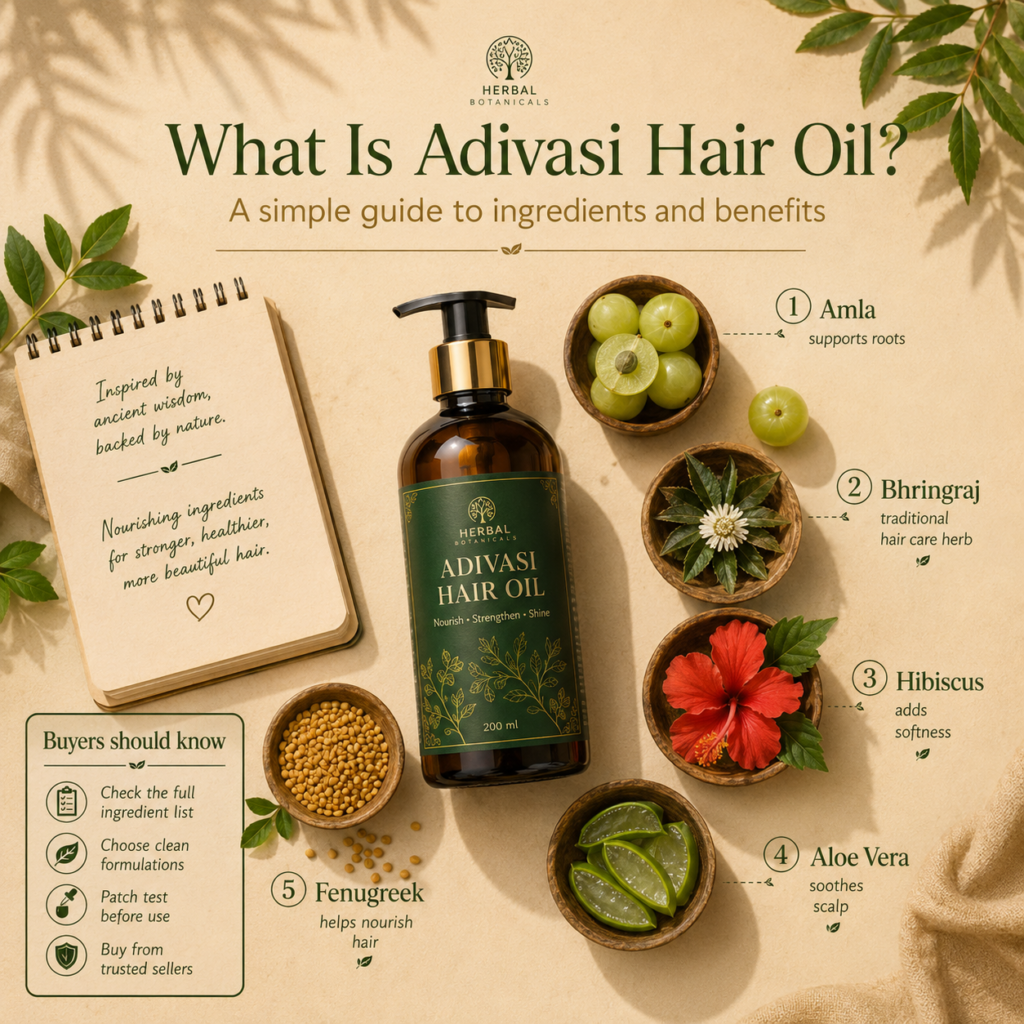
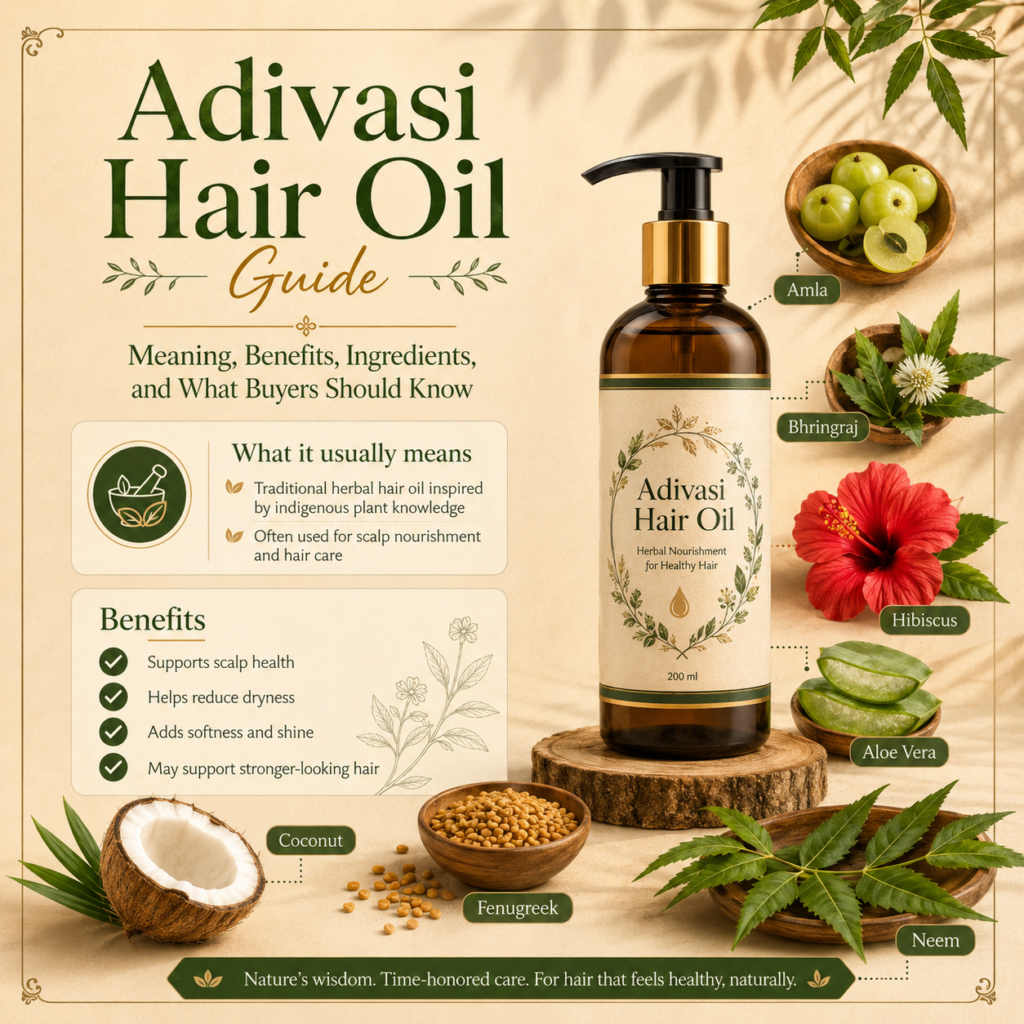
In the last few years, searches for natural adivasi herbal hair oil, adivasi ayurvedic herbal hair oil, Sneha adivasi herbal hair oil, and Adivasi Jeeva Sanjeevini herbal ayurvedic hair growth oil have increased because people are looking for traditional, herb-based hair care products instead of purely cosmetic oils.
The attraction is understandable. Indian hair care has a long history of using herbs, forest produce, seeds, roots, leaves, and natural oils. Many buyers believe that traditional herbal oils may be gentler, more natural, and more connected to older hair care knowledge.
But this topic needs care. The word “Adivasi” should not be used only as a marketing label. A product should be called Adivasi hair oil only when there is a genuine connection to Adivasi communities, traditional knowledge, sourcing, preparation, or community-led production. Otherwise, it is better and more honest to call the product a herbal hair oil, Ayurvedic hair oil, or traditional Indian hair oil.
This guide explains what Adivasi hair oil means, why such oils are popular, which herbs are commonly used in traditional hair oils, how Adivasi-style oils compare with Ayurvedic oils, and how buyers can avoid overclaimed products.
If you want a natural, herb-based oiling routine without unsupported claims, Taruveeda Ayurvedic Hair Oil can be considered as a practical Ayurvedic alternative for scalp nourishment and stronger-looking hair.
What Does Adivasi Hair Oil Mean?
Adivasi hair oil usually refers to a traditional herbal oil believed to be inspired by the plant knowledge, forest-based practices, or natural grooming traditions of Adivasi and tribal communities in India.
The word “Adivasi” broadly refers to India’s indigenous tribal communities. These communities have historically used local plants, forest produce, oils, herbs, flowers, roots, and seeds for food, wellness, grooming, and household use. Government-backed organisations such as TRIFED work with tribal communities and Minor Forest Produce because non-timber forest products are an important source of subsistence and cash income for people living in or near forests. TRIFED notes that Minor Forest Produce includes plant-origin products such as leaves, gums, waxes, dyes, resins, wild fruits, honey, nuts, and other forest-based materials. (trifed.tribal.gov.in)
In the hair care market, however, the term “Adivasi hair oil” is used in different ways. Some products may genuinely come from tribal producers or traditional community knowledge. Others may simply use the word because it sounds natural, rare, or traditional.
That is why buyers should ask a simple question:
Is this product genuinely connected to Adivasi sourcing, community production, or traditional knowledge, or is the word only being used for marketing?
A trustworthy product should be able to explain its ingredients, source, manufacturing process, claims, and usage instructions clearly.
Why Are Adivasi Herbal Hair Oils Popular?
Adivasi-style herbal hair oils are popular because they sit at the intersection of three strong consumer interests: natural beauty, traditional knowledge, and hair fall concern.
Many people are tired of products that promise instant hair growth but do not explain ingredients properly. They are looking for oils that feel more rooted, natural, and time-tested.
1. People Trust Traditional Hair Care
Hair oiling is already a familiar part of Indian households. Many people grew up seeing coconut oil, amla oil, herbal packs, methi paste, hibiscus, curry leaves, and other traditional remedies being used at home.
So when people see the phrase natural adivasi herbal hair oil, they associate it with old-style, non-cosmetic hair care.
2. Hair Fall Anxiety Is High
Hair fall is one of the biggest reasons people search for herbal oils. But hair fall is not always caused by the same issue. Mayo Clinic explains that people commonly shed around 50 to 100 hairs a day, and hair loss can be related to heredity, hormonal changes, medical conditions, stress, medicines, and nutritional factors. (Mayo Clinic)
This is why a responsible brand should not claim that any oil can stop all hair fall. A herbal oil may support scalp nourishment, reduce dryness, improve hair texture, and help with breakage-related fall, but medical hair loss needs medical attention.
3. Buyers Want Natural Ingredients
Consumers are now more aware of ingredient lists. They want to know what is inside the bottle. Oils with herbs such as bhringraj, amla, brahmi, neem, hibiscus, methi, and curry leaves feel more trustworthy than oils that only mention fragrance and mineral oil.
4. “Adivasi” Sounds Authentic
This is also where brands must be careful. Authenticity should not be borrowed without proof. If a product is not made by, sourced from, or directly connected to Adivasi communities, it should not pretend to be. A brand can still be natural, Ayurvedic, herbal, and effective without using a cultural identity inaccurately.
5. People Compare Before Buying
Searches for names such as Sneha adivasi herbal hair oil and Adivasi Jeeva Sanjeevini herbal ayurvedic hair growth oil show that many users are comparing products before buying. This blog should capture that comparison intent without attacking or overusing competitor names.
Common Herbs Found in Traditional Hair Oils
Traditional Indian hair oils often use herbs known for scalp nourishment, dryness control, root support, and hair texture improvement. The exact formulation differs by region, family practice, brand, and preparation method.
Below are some commonly used herbs and natural ingredients in traditional, herbal, and Ayurvedic hair oils.
1. Bhringraj
Bhringraj is one of the most recognised herbs in Ayurvedic hair care. It is traditionally used in hair oils for scalp nourishment and stronger-looking hair.
Research has explored Eclipta alba, commonly known as bhringraj, for hair growth-promoting activity in animal models. One PubMed-indexed study reported that extracts of Eclipta alba showed hair-growth activity in male albino rats, while another study reported dose-dependent activity in mice. These findings are useful but should be interpreted carefully because animal studies are not the same as large human clinical trials. (PubMed)
2. Amla
Amla is widely used in Indian hair care because it is associated with shine, strength, and scalp nourishment. It is used in oils, powders, shampoos, and herbal masks.
Amla is commonly included in traditional oils for:
- Dull hair
- Weak-looking strands
- Rough hair
- Dryness
- Shine and smoothness
3. Brahmi
Brahmi is traditionally used in Ayurvedic formulations for cooling, calming, and scalp comfort. It is often used in oils meant for gentle massage and relaxation.
4. Neem
Neem is mostly known as a scalp-care herb. It is commonly used where people have scalp discomfort, itchiness, oiliness, or dandruff-prone concerns.
Neem-based oiling should still be used sensibly. If the scalp has severe scaling, wounds, redness, swelling, or infection-like symptoms, a dermatologist should be consulted.
5. Hibiscus
Hibiscus is used in many traditional Indian hair packs and oils. It is associated with softness, conditioning, and hair texture support.
6. Methi
Methi, or fenugreek, is a common home remedy ingredient. It is often used for hair masks and oil infusions because it helps with softness and roughness control.
7. Curry Leaves
Curry leaves are often used in homemade oils. Many Indian households boil or infuse curry leaves in coconut oil for traditional hair nourishment.
8. Coconut Oil
Coconut oil is one of the most common base oils in Indian hair care. It is widely used for pre-wash oiling, dryness control, and hair softness.
9. Sesame Oil
Sesame oil is often used in Ayurvedic preparations. It has a stronger traditional Ayurvedic association and is commonly used as a carrier oil.
10. Castor Oil
Castor oil is thicker than many other oils and is often used in small quantities. It may help improve the feeling of density and coating, but because it is heavy, it may not suit every scalp.
Adivasi Hair Oil vs Ayurvedic Hair Oil
Adivasi hair oil and Ayurvedic hair oil are often discussed together, but they are not exactly the same.
| Factor | Adivasi-Style Herbal Hair Oil | Ayurvedic Hair Oil |
| Main identity | Connected to tribal, indigenous, or forest-based traditional knowledge | Based on Ayurvedic principles and herbs |
| Ingredient style | Local herbs, roots, leaves, seeds, forest produce | Ayurvedic herbs such as bhringraj, amla, brahmi, neem |
| Authenticity requirement | Should have genuine community, sourcing, or traditional connection | Should follow Ayurvedic formulation logic or herbal tradition |
| Risk in marketing | Cultural label may be misused | “Ayurvedic” may be used loosely without formulation clarity |
| Best buyer approach | Check source, maker, ingredients, and claims | Check herbs, base oil, usage, and scalp suitability |
The difference matters because buyers deserve honesty. A product can be excellent without being called Adivasi. Likewise, a product can be Ayurvedic and natural without claiming tribal identity.
Taruveeda should be positioned clearly as a natural Ayurvedic hair oil, not as an Adivasi oil unless there is factual sourcing or formulation evidence.
This is better for long-term brand credibility.
How to Avoid Fake or Overclaimed Hair Oil Products
The herbal hair oil market is full of strong claims. Some products may be useful, but others rely heavily on emotional words such as “ancient secret,” “tribal formula,” “miracle growth,” or “100% hair fall stop.”
A responsible buyer should check the product carefully.
1. Check Whether the “Adivasi” Claim Is Explained
If a brand says “Adivasi hair oil,” it should explain at least one of the following:
- Which community or region is connected with the formulation
- Whether tribal producers are involved
- Whether ingredients are sourced through tribal groups
- Whether there is fair sourcing or community benefit
- Whether the formula is actually traditional or only inspired
- Whether there is any certification, cooperative, or traceability
TRIFED’s work shows why ethical sourcing matters: Minor Forest Produce provides livelihood support to tribal people, and Van Dhan programmes are designed to improve value addition and income from forest produce. (trifed.tribal.gov.in)
If a product uses the word “Adivasi” but gives no proof, treat it as a marketing claim.
2. Read the Ingredient List
Do not buy only because the front label says “natural” or “herbal.” Check the ingredient list.
Look for clarity around:
- Base oil
- Herbs used
- Extracts or infusions
- Fragrance
- Preservatives if any
- Colour additives if any
- Usage instructions
- Manufacturer details
If the product makes big claims but hides the ingredient list, avoid it.
3. Avoid Miracle Claims
Be cautious with claims such as:
- Grow hair in 7 days
- Stop hair fall permanently
- Regrow bald patches naturally
- Cure baldness
- Guaranteed hair growth
- No hair fall after one use
Hair loss can have medical, hormonal, genetic, nutritional, and scalp-related causes. A hair oil may support hair care, but it should not claim to cure medical hair loss.
India also has regulatory concern around misleading advertisements for Ayush products. A PIB release noted that dubious claims and misleading advertisements of Ayush products had been reported through pharmacovigilance centres, the GAMA portal, and ASCI, and it referred to legal restrictions on exaggerated claims under the Drugs and Magic Remedies framework. (Press Information Bureau)
4. Check Whether the Product Suits Your Scalp
A good oil for one person may not suit another.
| Scalp / Hair Type | What to Check |
| Dry scalp | Nourishing base oil, not too light |
| Oily scalp | Use smaller quantity, avoid heavy overnight oiling |
| Dandruff-prone scalp | Avoid oils that increase itching or flakes |
| Sensitive scalp | Patch test first |
| Long hair | Apply to scalp and lightly to length |
| Breakage-prone hair | Look for conditioning and softness support |
5. Patch Test Before Regular Use
Natural does not always mean irritation-free. Apply a small amount behind the ear or on a small scalp area and wait 24 hours. If you notice itching, redness, burning, swelling, or rash, do not continue.
6. Check Reviews Carefully
Reviews can help, but do not trust only before-after photos. Hair changes can be affected by lighting, styling, hair wash condition, camera angle, and editing.
Look for reviews that mention:
- Texture
- Smell
- Washability
- Scalp comfort
- Reduced dryness
- Hair softness
- Long-term use
- Whether it caused irritation
7. Know When Hair Oil Is Not Enough
See a dermatologist if you have:
- Sudden heavy hair fall
- Patchy bald spots
- Severe dandruff
- Pain, swelling, or redness
- Scalp wounds
- Hair thinning that keeps increasing
- Hair loss after illness or medication
- Hair loss with thyroid, PCOS, pregnancy, or hormonal concerns
A herbal oil can support care, but it should not delay proper diagnosis.
Taruveeda Hair Oil as a Natural Ayurvedic Alternative
Taruveeda Hair Oil should be positioned honestly: it is a natural Ayurvedic hair oil alternative for people who are searching for traditional herbal hair care but want clear, responsible claims.
It should not be promoted as an Adivasi hair oil unless you have genuine evidence of Adivasi sourcing, community involvement, or traditional formulation rights. That honesty itself improves trust.
Taruveeda Ayurvedic Hair Oil is suitable for users looking for:
- Herbal Ayurvedic hair oil
- Natural hair oil for scalp nourishment
- Ayurvedic oil for stronger-looking roots
- Pre-wash oil for dry and rough hair
- Hair oil for weekly massage
- Natural alternative to overclaimed hair oils
- Traditional Indian hair care routine
Why Taruveeda Fits This Search Intent
People searching for Adivasi herbal oils usually want natural, traditional, herb-based hair care. Taruveeda can meet that broader need without misusing the Adivasi label.
The positioning should be:
If you are looking for a traditional-style herbal oil but want clear Ayurvedic positioning and realistic claims, Taruveeda Hair Oil is a natural choice for regular scalp and hair nourishment.
Suggested Usage Routine
Use Taruveeda Hair Oil 2 to 3 times per week before washing.
- Detangle your hair gently.
- Apply oil to the scalp in sections.
- Massage with fingertips for 5 to 10 minutes.
- Apply a small amount to the hair length if dry.
- Leave for 1 to 3 hours.
- Wash with a mild shampoo.
For a complete routine, pair it with Taruveeda Herbal Shampoo and explore more Ayurvedic hair products.
Final Thoughts
Adivasi hair oil is popular because buyers are searching for traditional, natural, herb-based hair care. But the term should be used responsibly. A product should not be called Adivasi only because it contains herbs or looks traditional. There should be a real connection to Adivasi knowledge, sourcing, production, or community benefit.
For buyers, the safest approach is to check the ingredient list, source transparency, usage instructions, product claims, and scalp suitability. Avoid products that promise instant growth or permanent hair fall cure.
For Taruveeda, the stronger long-term positioning is clear and credible:
Taruveeda is a natural Ayurvedic hair oil for scalp nourishment, stronger-looking hair, and regular herbal hair care — not an overclaimed “miracle” oil.
If you want a responsible alternative to heavily marketed Adivasi-style hair oils, Taruveeda Ayurvedic Hair Oil can be a practical choice for your weekly hair care routine.
FAQs About Adivasi Herbal Hair Oil
1. What is Adivasi hair oil?
Adivasi hair oil usually refers to a traditional herbal hair oil believed to be inspired by Adivasi or tribal plant knowledge, forest-based ingredients, or natural hair care practices. However, the term should only be used when there is genuine connection to Adivasi sourcing, preparation, or community involvement.
2. Is Adivasi hair oil the same as Ayurvedic hair oil?
No, not exactly. Adivasi-style hair oil is usually associated with tribal or forest-based traditional knowledge. Ayurvedic hair oil is based on Ayurvedic herbs and principles. Some ingredients may overlap, but the identity and sourcing are different.
3. Is natural adivasi herbal hair oil good for hair growth?
A natural herbal oil may support scalp nourishment, reduce dryness, improve hair texture, and help with breakage-related hair fall. But no oil should claim guaranteed hair growth or baldness cure. Hair growth depends on genetics, hormones, scalp health, nutrition, stress, and overall health.
4. What ingredients are commonly found in traditional herbal hair oils?
Common ingredients include bhringraj, amla, brahmi, neem, hibiscus, methi, curry leaves, coconut oil, sesame oil, castor oil, and other regional herbs. The exact formulation depends on the brand and tradition.
5. How can I know if an Adivasi hair oil is genuine?
Check whether the brand explains its sourcing, community connection, ingredients, manufacturing details, and claims. If the product uses the word “Adivasi” but gives no proof or transparency, treat it carefully.
6. Are Sneha adivasi herbal hair oil and Adivasi Jeeva Sanjeevini hair oil the only options?
No. These are brand/search terms people use while comparing products. Buyers should compare all oils based on ingredient quality, scalp suitability, transparency, reviews, claims, and value, not only brand name.
7. Can Taruveeda Hair Oil be called Adivasi hair oil?
No, Taruveeda should not be called Adivasi hair oil unless there is factual evidence of Adivasi sourcing, production, or formulation. Taruveeda is better positioned as a natural Ayurvedic hair oil for scalp nourishment and stronger-looking hair.
8. How often should I use herbal Ayurvedic hair oil?
Most people can use herbal Ayurvedic hair oil 2 to 3 times per week before washing. If your scalp is oily or dandruff-prone, use less oil and leave it for a shorter time. If your hair is dry or long, apply lightly to the hair length as well.
9. Can herbal hair oil stop hair fall completely?
Herbal hair oil may help reduce hair fall caused by dryness, breakage, poor scalp care, or rough handling. It may not stop hair fall caused by genetics, hormones, thyroid issues, illness, nutritional deficiency, medication, or scalp disease.
10. What should I avoid while buying Adivasi herbal hair oil?
Avoid products with unclear ingredients, exaggerated claims, fake before-after photos, no manufacturer information, no usage instructions, or claims like “grow hair in 7 days” and “permanent cure for baldness.”